
For years, the main question surrounding a bank’s alert systems was simple: did the message go out? Today, that is no longer enough. A fraud alert that arrives late loses much of its value, an OTP stuck in a queue can block a transaction, and a communication that cannot be demonstrated during an audit leaves the bank without sufficient evidence of what happened.
A bank can have more channels, more providers and more controls than ever and still have lost visibility over the full lifecycle of its communications.
This shift is also taking place in a context of rapidly accelerating transaction volumes. According to the World Bank, fast payments in Latin America and the Caribbean grew from 620 million transactions in 2017 to 79.8 billion in 2024 and now account for 45% of the region’s digital payment volume. As transactions become more immediate and numerous, the demands placed on the communications that accompany them also increase.
The issue is no longer just about sending messages, but about deciding what should be communicated, maintaining delivery when something fails, supervising the process and preserving evidence of each notification. This is where banking communications governance begins.
What does it mean to govern banking communications?
An alert system can operate for years without being truly governed. The difference lies in the degree of control: a functioning system delivers messages, but a governed system also makes it possible to establish what is communicated, with what priority, through which channel, what happens when a provider fails and what evidence remains of the entire process.
Banking communications governance means controlling the full lifecycle of each notification, from the event that triggers it to the final evidence of its delivery.

From a functioning system to a governed system
In a traditional architecture, communication rules tend to grow around the applications that need them. Fraud develops its own flows, cards its own, the core banking system others, and digital channels add new integrations as new needs emerge.
Each component may work correctly on its own. The problem arises when the bank needs to answer end-to-end questions:
- What exactly happened with a specific alert?
- What priority did it have?
- Which provider processed it?
- Was another channel attempted?
- How long did it take?
- Is there a record ready to prove it?

When the answers are spread across applications, middleware, providers and independent logs, there is control over parts of the process, but not necessarily over the entire lifecycle.
The governance gap
Latinia’s Banking Alerts Governance Guide defines the governance gap as the distance between the compliance status an institution declares and its actual ability to prove it for a specific notification.
It is particularly difficult to detect because it can remain hidden during normal operations and surface precisely when there is the least room to react: during a transaction peak, when a provider goes down or in response to an audit request.
Adding more channels or providers does not necessarily eliminate it either. If each new integration is added outside a common layer, fragmentation can increase rather than decrease.
Why a multichannel architecture can lead to a loss of control
Multichannel capabilities expand a bank’s options, but more channels do not automatically mean more control.
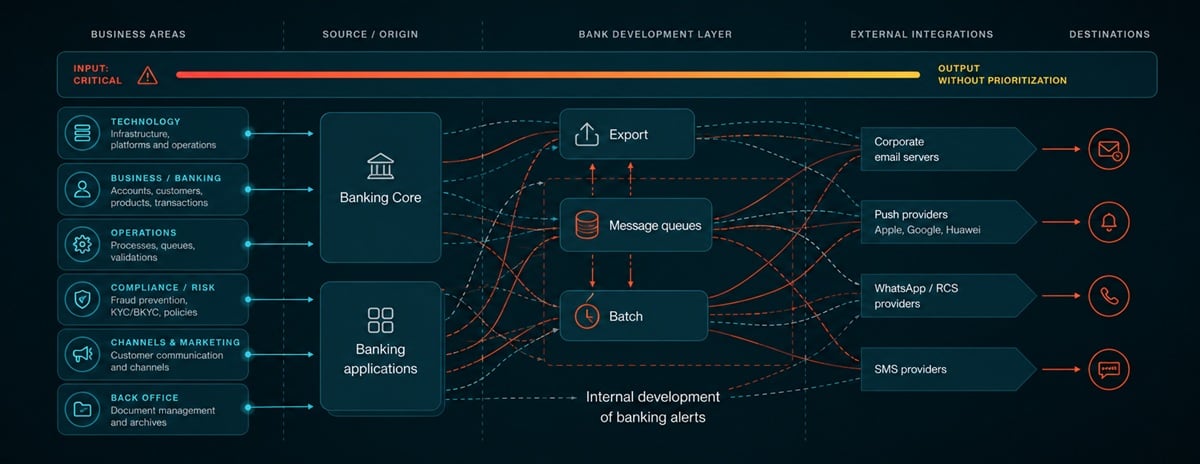
SMS, push, email, RCS and other channels can coexist with different providers and business applications. The problem arises when each application maintains its own communication logic and connects independently to those channels.
Fragmentation across applications, teams and providers
Several patterns tend to recur in this type of architecture:
- Rules governing what to communicate and with what priority reside in different applications.
- Providers have been progressively integrated through point-to-point connections.
- Delivery statuses are distributed across different repositories.
- Changing a rule may require changes to several systems.
- Changing providers or adding a new channel increases complexity.
- Reconstructing the journey of a communication requires consulting different sources.
The result is that technology fragmentation eventually becomes fragmented responsibility. Replacing an old component with a more modern one does not necessarily solve the problem: if responsibility remains distributed, the architecture can change without the governance model really changing.
The following diagram shows exactly this situation: each area maintains its own route to the customer and different controls over the process, but there is no common layer preserving priority and traceability from end to end.
Continuity, traceability and cost
Latinia’s guide identifies four main areas where this lack of control ultimately becomes visible:
Technology obsolescence and fragmentation. Each new integration increases dependencies between systems and makes change more difficult.
Service continuity. A transaction peak, provider outage or channel saturation can affect precisely the communications that should receive the highest priority.
Regulation, traceability and reputation. Having dispersed logs is not the same as having evidence ready to respond to a regulator.
Economic and opportunity cost. The architecture requires more infrastructure, integration and maintenance, while each change can delay new business initiatives.
Continuity and quality in banking notifications is therefore part of the problem, but not the whole of it. Governance adds a prior question: who controls the lifecycle and where does the ability to make decisions over it reside?
The pressure on operational resilience is not theoretical either. The European Banking Authority received more than 1,200 reports of major ICT incidents during the first four months of 2025, with a particular impact on technology systems, payment services and online banking.
The four functions of a governed architecture
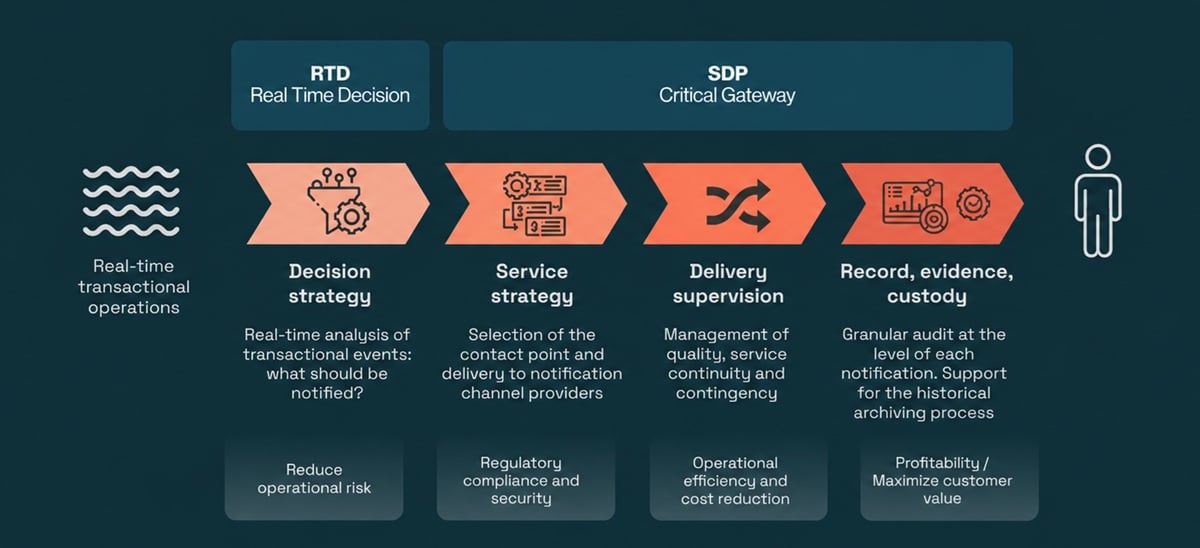
Governing a communication means controlling what happens before, during and after delivery. Latinia’s guide structures this lifecycle around four functions: decide, deliver, supervise and evidence.
Decide
The criticality of each communication must be part of the decision. A fraud alert or an OTP should not compete on equal terms with bulk traffic, so the architecture needs to interpret the event, apply the relevant rules and determine what is communicated, to whom, when and with what priority, before the message reaches the channel.
Deliver
Once the decision has been made, the appropriate contact point, channel and provider must be selected. This involves applying delivery rules, time windows, limits and alternative routes, as well as managing the orchestration of banking notifications across different channels and providers.
Supervise
The bank’s responsibility does not disappear when the message leaves its systems. If a provider fails, a channel degrades or traffic increases sharply, the architecture must detect what is happening and activate the necessary contingency mechanisms.
Failover, load balancing, prioritization and channel rerouting make it possible to sustain delivery of critical communications without requiring manual intervention in each application.
Evidence
The final function is to preserve a complete record of what happened. It is not simply a matter of knowing that a delivery attempt took place, but of being able to reconstruct what communication was generated, when, through which route and with what result.
In this context, evidence ceases to be a technical by-product and becomes part of the communication lifecycle itself.
The Banking Alerts Governance Guide includes real-world cases, return metrics and a 12-question framework for assessing the level of control over the architecture.
Download the full guide.
How Latinia helps govern banking communications
Latinia acts as an internal intelligence and governance layer between the bank’s applications and channel providers, centralizing control over the communications lifecycle without the need to rebuild the core banking system. This allows different applications to delegate decisions such as priority, channel or provider selection, delivery rules and contingency management to a common layer. You can explore this approach in more detail in Latinia’s Operational Governance solution.
Within Latinia’s architecture, these functions are divided between two complementary components: the Real-Time Decision Engine (RTD), which evaluates transactional events and determines what should be communicated and with what priority, and the Critical Alerts Engine (SDP), which manages delivery, continuity and supervision of critical communications.
This makes it possible, for example, to prioritize an OTP or fraud alert over less critical traffic, reroute a communication when a provider fails and maintain consolidated traceability throughout the process. The last mile still depends on channel providers, but the bank retains control over how that last mile is used and what happens when something fails.
This model is complementary to customer engagement platforms, not a replacement for them. While those platforms are mainly oriented toward campaigns and customer journeys, the governance layer focuses on critical communications linked to transactional events, where priority, continuity and evidence are especially important.
What changes when communications are governed
Although governance may initially appear to be an architectural issue, its effects are ultimately reflected in operational and economic metrics. The cases included in the guide show this from different perspectives.
Greater continuity and priority for critical communications
At one of the institutions analyzed, communications entered the system with a default priority that did not adequately distinguish between critical and bulk traffic. During traffic peaks, only 28.7% of notifications were delivered in under two seconds.
After introducing a critical gateway and an explicit prioritization policy for OTPs and critical alerts, the SLA within that threshold rose to 96.4%.
The improvement did not simply come from increasing available capacity, but from making criticality explicit and governing traffic accordingly.
Greater efficiency and scalability
Another case began with a strong dependence on SMS: traffic on this channel was growing at 200% per year, while only 17% of the customer base was digital.
The gradual introduction and prioritization of push allowed the bank to absorb growth through digital channels. In the scenario analyzed, the saving per message compared with the traditional channel reached 97%, while push traffic grew by 600% between 2022 and 2025.
Channel efficiency does not depend solely on adding new options, but on having an architecture capable of deciding which traffic can be shifted, when and under which rules, something also covered in the 7 pillars of the push channel in banking.
In another case from the guide, the challenge was to replace a 19-year-old proprietary development while the institution prepared to increase its annual message volume fivefold. The project achieved an IRR of 135% and paid back the investment in month nine.
A return that can also be measured
The economic impact is not limited to savings on infrastructure or channels. A Total Economic Impact™ study conducted by Forrester Consulting and commissioned by Latinia analyzed the implementation of the Real-Time Decision Engine at a Latin American bank and projected its effects over five years.
The model estimated:
- 162% ROI
- USD 6.66 million NPV
- payback in less than six months
- USD 10.78 million in risk-adjusted benefits
The benefits came mainly from new messaging subscription revenue, replacement of legacy SMS infrastructure and reduced time-to-market.
These results relate to one specific institution and model and do not constitute a guarantee for other banks. The TEI framework itself recommends that each organization use its own assumptions to assess the potential impact of the investment. More information about the study is also available in Latinia’s Total Economic Impact report.
Can your bank prove that it governs its communications?
Governance should not be assessed solely by asking whether the system is available. There are more revealing questions:
- Is there a single owner responsible for the full communication lifecycle?
- Can the bank identify every route through which a communication reaches the customer?
- Is the priority between a critical alert and bulk traffic explicitly defined?
- Is there a documented failover test?
- Can evidence of a notification sent months ago be retrieved quickly?
- Is the total annual cost of maintaining the current architecture known?
- How many systems need to be modified to introduce a new business rule?
From diagnosis to a governed architecture
A negative answer, or one that is difficult to document, may point to part of the governance gap. The question is not simply whether alerts work today, but whether the bank can decide, sustain and prove each one even when volumes increase, a provider fails or a regulatory requirement arises.
The Banking Alerts Governance Guide develops this framework in depth and includes reference architectures, real-world cases, return metrics and a 12-question self-assessment for identifying potential governance gaps.
Download the full guide and assess how much control your bank really has over the lifecycle of its communications.
If you want to learn how Latinia can add this control layer to your current architecture, explore our operational governance solution for banking communications or contact us to discuss your institution’s needs.
Frequently asked questions about banking communications governance
What is banking communications governance?
Banking communications governance is the control of the full notification lifecycle: deciding what should be communicated, delivering it through the appropriate route, supervising its execution and preserving traceable evidence of what happened. Its purpose is to prevent responsibility from becoming fragmented across applications, channels and providers.
What is the difference between governance and notification orchestration?
Orchestration focuses mainly on coordinating delivery across different channels, providers and rules. Governance covers a broader framework: it includes the decision beforehand, the priority of each communication, delivery and contingency, supervision and subsequent evidence.
Orchestration is therefore one part of the governed lifecycle, not the entire lifecycle. You can explore this topic in more detail in our article on banking notification orchestration.
Can a customer engagement platform manage critical banking alerts?
Customer engagement platforms and a governance layer for critical communications perform different functions and can work together in a complementary way.
The former are designed mainly for campaigns, segmentation and customer journeys. Critical communications start from a different unit of management: the transactional event, where real-time response, priority over other messages, continuity in the event of failures and the preservation of auditable evidence can be decisive.