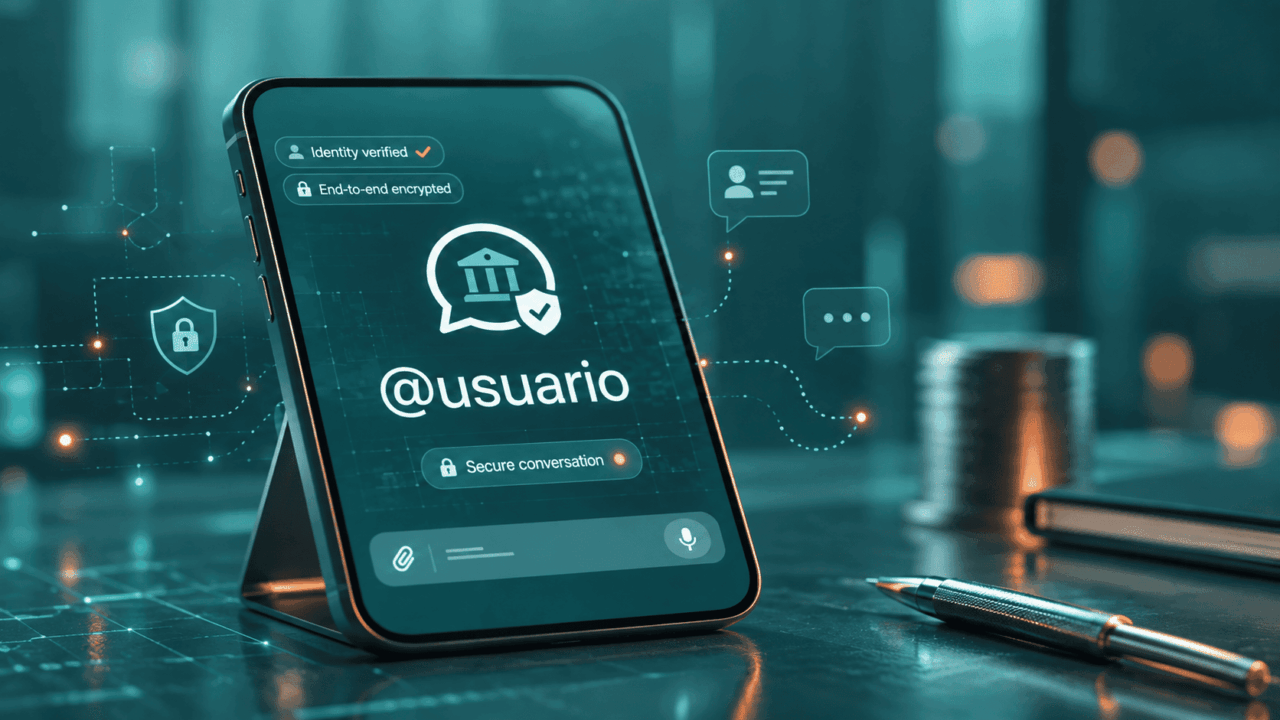
Meta is rolling out usernames in WhatsApp as a contact identifier, replacing phone numbers. For users, it means greater privacy: Whatsapp Usernames. For most businesses, it is an architectural challenge. For banks, it is a clear signal that a customer’s contact data will no longer always be a phone number.
For over fifteen years, WhatsApp has operated on a single, immovable principle: the phone number is the identifier. No aliases, no usernames, no way to reach someone without knowing their mobile number. That logic has shaped how banks integrate WhatsApp into their communication workflows, how CRMs store contacts, and how the entire WhatsApp Business API functions.
That principle is about to change.
What is happening — and why now
Meta has begun a gradual rollout of WhatsApp usernames, a feature the company had been developing for some time and that had already surfaced in beta environments and early builds. The launch will be phased: initially limited to a select group of users in pilot markets — with Colombia, Peru, and the Dominican Republic among the first in the region — before expanding over the coming months.
Why now?
The answer has several layers.
- The first is competitive pressure: Telegram and Signal have offered usernames for years, and WhatsApp — with over two billion users — was the only major messaging platform still requiring users to expose their phone number to interact.
- The second is privacy: every time a user shares their number to receive commercial messages, they are exposing data that can be used to track, harass, or spam them.
- The third, and perhaps most strategic for Meta, is ecosystem integration: usernames will be linkable directly to the user’s Instagram and Facebook accounts, deepening cohesion across its platforms.
The rules of the new identifier are straightforward: between 3 and 30 characters, lowercase letters, numbers, dots, and underscores only. No domains, no web-style formats. And crucially: users will be able to choose whether to share their phone number or only their username when initiating or accepting a conversation.
The new reality: when the customer decides what to share
Until now, when a customer started a conversation with their bank through WhatsApp Business, the company automatically received the phone number linked to that account. It was the universal identifier — the entry point to every downstream workflow.
With usernames, that automaticity disappears. If a user reaches out proactively and chooses to share only their username — not their number — the company receives that identifier without access to the phone number. To proceed with any flow that requires it, the bank will have to ask the customer explicitly.
This is not a minor technical adjustment. It is a shift in the architecture of consent.
The customer moves from passively surrendering their number by default to actively deciding how much information to share. Any business unprepared to handle conversations where the identifier is a username — not a phone number — will encounter friction in flows that currently run without it.
What does this mean for banking communication?
Meta has introduced a new technical field called BSUID — a proprietary system identifier — that now appears in all WhatsApp Business API webhooks, regardless of whether the user has activated a username.
This means banking systems will soon receive up to three possible identifiers per interaction:
- The phone number
- The username
- The BSUID
Any architecture with a single field for “phone number” will be incomplete.
CRMs, customer service systems, and banking cores will need to store multiple identifiers per contact and link them to maintain conversation continuity. This is not an optional upgrade: the deadline for businesses to have their systems updated is June 2026.
It is worth distinguishing between two distinct use cases for WhatsApp in banking.
Outbound alerts — transactional notifications, OTPs, fraud warnings, operation confirmations — are not immediately affected. In these flows, the bank already holds the customer’s phone number, obtained at onboarding or service activation. Communication is proactive, bank-to-customer, and does not depend on the customer initiating the conversation or choosing what to share. For this type of use, WhatsApp’s change alters nothing in the short term.
This is precisely the model in which Latinia operates: a real-time decision engine that uses the number already present in the banking core, with no dependency on WhatsApp’s evolving identifier policies.
Inbound conversations are a different matter. When a customer initiates contact — a query, a complaint, a request — and chooses not to share their number, the bank is left with a username as the only available identifier. If its systems cannot map that username to an existing customer profile, the flow breaks down.
Signals about where the channel is heading
The WhatsApp username rollout is not just a product update. It is a signal about the direction digital privacy is taking across messaging channels.
Users have long demanded control over what data they share and with whom. The ability to interact without exposing a phone number responds to that demand directly, particularly in commercial contexts where customers want to maintain a layer of privacy.
In banking, where trust is the foundation of the relationship, that customer preference is not trivial — it is data the bank should be listening to.
The trend points toward an environment where the phone number will no longer be the universal, default-shared identifier.
Banks that anticipate this shift, that build systems capable of handling multiple identifier types, and that design conversation flows that do not assume automatic access to a phone number, will be far better positioned when the change reaches full scale.
The strategic agenda for banks today
The first step is not technical — it is conceptual.
- Understanding that the WhatsApp identifier may no longer be a phone number in certain flows, and that this affects how conversations are linked to customer profiles in the CRM or banking core.
- The second step is auditing which WhatsApp flows depend on receiving a phone number automatically. Are there customer service flows that assume that data? Are there integrations that will fail if the incoming identifier is a username rather than a phone number?
- The third step is preparing the data architecture to store and relate multiple identifiers per customer — not as a long-term project, but as a design decision worth making before the rollout becomes widespread.
For banks already working with real-time notification solutions focused on outbound flows, the immediate priority is low. But getting ahead of the inbound-username scenario is an architectural decision best made deliberately, not under pressure.
Key takeaways
At Latinia, we believe WhatsApp usernames represent one of the most significant changes in the platform’s history — not because they break what works today, but because they introduce a new variable into the equation: the customer decides what identity to share, and businesses must be able to operate with that choice.
For banking, the immediate impact on outbound notifications is minimal. The impact on inbound conversational flows is real and will grow as the rollout progresses. And the underlying signal — that control over contact data is shifting toward the user — is a trend the financial sector cannot afford to ignore.
The question every institution should be asking today is not “does this affect us?” It is:
“Are we ready to operate in a world where a phone number is not always the starting point of the customer relationship?”
Latinia has spent over 25 years helping banks turn financial events into precise, relevant communications — through the right channel, at the right moment. Learn how our real-time decision engine works, or get in touch to explore how to prepare your communication flows for the changes ahead.