
Last updated: October 20, 2026
To compete with fintechs, neobanks and Big Tech, traditional banks need a digital banking strategy that brings together agile processes, connected data, customer experience and real-time responsiveness. Digital transformation is a means to compete better, not an end in itself.
Competition from fintechs and digital banks is forcing traditional banks to rethink their strategy: offering more online services isn’t enough. They need to combine efficiency, data and a relevant customer experience.
Key takeaways
- Gaining a competitive edge means modernizing processes and reducing friction for customers.
- Data makes it possible to personalize services and make decisions in the right context.
- Timely, real-time communications strengthen the banking experience.
- Competitiveness doesn’t depend on technology alone, but on how it’s built into the bank’s strategy.
The challenge of competing in the digital age
The rapid rise of fintechs, Big Tech and digital banks has radically transformed the financial sector. These new players have set a high bar for customer experience, offering seamless, easy-to-use digital services tailored to individual needs. For traditional banks, the challenge isn’t just competing with their peers, but keeping pace with these digital disruptors
Consumer expectations have shifted significantly, and many now demand fast, personalized and accessible services. According to a BAI report, 85% of millennials would consider banking with a non-traditional financial institution, and 79% have opened an account online. This shift toward digital, always-on financial services highlights the need for traditional institutions to adapt their strategies.
Banks that fail to modernize risk losing market share to these more agile competitors. But competing today isn’t just about launching an app or digitizing a few processes. The real challenge is reaching a level of digital maturity that allows the bank to embed technology across its entire operations, become more efficient, reduce friction and respond more precisely to what customers expect.
This requires digitalization to stop being a standalone project and become part of how the bank works at every level. That’s why a digital banking strategy isn’t measured only by the number of digitized services, but by its ability to differentiate the bank’s offering, simplify its operations and better serve its customers.
The new competition: Understanding digital financial players
The financial sector has seen growing competition from digital players, including fintechs, neobanks and Big Tech companies like Apple, Google and Meta.
These new players are quickly gaining market share by combining advanced technology with a strong focus on customer experience to deliver innovative, user-centric financial solutions. This new kind of competition is driving a shift in how financial services are delivered and consumed.
The rise of fintechs and neobanks
Fintechs and neobanks have built their success on delivering end-to-end digital services. Platforms like Chime, SoFi, Neo Financial and Revolut have emerged as leaders in digital banking, giving customers a streamlined experience through mobile apps, faster payments and lower fees. Unlike traditional banks, fintechs and neobanks don’t rely on physical branches, which lets them operate with lower overhead and focus entirely on digital convenience.
On top of that, many of these players are data-driven from day one. Free from legacy systems and fragmented internal structures, they can organize information more effectively, connect teams more nimbly and use data from the outset to personalize services, automate decisions and bring new products to market faster.
Big Tech moves into financial services
Big Tech companies like Apple, Google and Meta have moved into financial services, leveraging their massive user bases and technological expertise. Products like Apple Pay, Google Pay and Meta Pay (formerly Facebook Pay) have made it easier than ever for consumers to make payments, send money and even manage digital wallets without ever setting foot in a bank.
These companies are tapping into their existing ecosystems to weave financial services into everyday digital interactions, making them powerful competitors to traditional banks.
At the same time, the growth of open banking, Banking as a Service and embedded finance has opened up the playing field even further. In this landscape, Big Tech, fintechs and data aggregators are finding new ways to take part in the financial value chain and strengthen their position against traditional banks.
The threat to traditional banks
The rise of fintechs and Big Tech poses a significant threat to traditional banks. These digital companies offer a level of personalization and convenience that many traditional institutions struggle to match. They use customer data and cutting-edge technology to create tailored experiences that make it easier for consumers to manage their finances. Many customers are also drawn to the transparency, lower fees and faster service these competitors offer.
Traditional banks need to meet these challenges by adopting their own digital-first strategies. To compete, they must streamline their services, use real-time communications and leverage customer data to deliver more personalized, efficient experiences. The threat posed by these new players is real, but it’s also an opportunity for traditional institutions to innovate and modernize.
On top of that, there’s added pressure: launching standalone digital initiatives isn’t enough. Banks need to reach a level of maturity that lets them operate as fully digital organizations, with connected processes, faster decision-making and a far more contextual relationship with their customers.
It all comes down to customer experience
Customer experience (CX) sits at the heart of this digital transformation. Today’s customers care less about the traditional perks of banking and more about how easy, fast and personalized their financial interactions are. Seamless, digitally driven user experiences have become a priority for consumers, who expect every interaction with their bank to be intuitive, instant and tailored to their needs.
Banks that put customer experience first, by offering personalized, real-time services and keeping communication consistent across every channel, can build stronger customer loyalty and trust.
Institutions that don’t put it at the center, on the other hand, risk falling behind in the race to meet digital consumers’ expectations.
The gap between what banks aim to deliver and what they actually achieve is still clear. While many institutions say customer centricity is a priority, not all of them manage to turn that goal into consistent results.
While 80% of commercial banking decision-makers see customer centricity as a high priority, only 47% of banks are exceeding customer expectations, and just 15% do so consistently. – KPMG
Part of that gap comes down to how data is managed, how internal systems are connected and how well the bank can draw on APIs, external partnerships and analytics capabilities to better serve each customer.
As the landscape continues to evolve, it’s clear that customer experience isn’t just one part of success. It’s everything. Financial institutions that deliver a superior customer experience won’t just compete effectively; they’ll thrive in this new digital world.
Key strategies for competing in a digital world
A bank’s digital strategy needs to translate into advantages customers can actually feel and into lasting operational improvements. To compete with fintechs and neobanks, traditional institutions need to modernize their services and processes, make better use of data, personalize the experience and use real-time communications to meet each customer’s needs at the right moment.
These areas of focus work hand in hand. Technology alone doesn’t guarantee a competitive edge, but when it’s built into the bank’s operations, it can turn transactional data and events into relevant, personalized and timely communications, strengthening the customer relationship beyond digital channels.
How to build a competitive digital banking strategy
An effective digital banking strategy starts by pinpointing where the bank is losing ground to fintechs: slow processes, fragmented experiences, underused data or communications that arrive too late and miss the context. That assessment should translate into concrete priorities, not a scattershot list of technologies.
From there, the bank can combine three areas of focus: simplifying the digital services that create the most friction; connecting customer and transaction data to make better decisions; and triggering real-time communications that inform, protect or offer a useful response when a relevant event occurs. For example, detecting an unusual transaction and flagging it in time delivers a different kind of value than launching a generic campaign, even though both rely on customer information.
Execution also requires clear KPIs. Beyond measuring channel adoption and process efficiency, it’s worth assessing how timely and useful communications are: whether they arrive at the right moment, address a real need and respect customer preferences. That way, the digital strategy ties back to tangible service and experience outcomes, rather than being reduced to modernizing an app.
Digital transformation and streamlined services
To stay competitive, banks need to invest in advanced technologies such as mobile banking, online account opening and digital lending. Customers increasingly expect convenience and speed when accessing financial services, and any friction along the way can lead to dissatisfaction.
According to The Financial Brand, using technology to simplify processes ensures financial institutions can deliver faster, smoother customer experiences, from opening an account to applying for a loan.
Upgrading back-end systems and digitizing operations allows traditional banks to cut wait times, improve customer satisfaction and stay competitive in a landscape where fintechs and neobanks are pulling ahead on the strength of their superior customer experience. These improvements make processes faster and more efficient, helping banks meet the demands of today’s digital consumers.
Modernization is a prerequisite for competing, but its real value comes through when it reduces friction and improves service. For a closer look at the stages of this process, check out this digital banking transformation roadmap.
From traditional bank to data-driven bank
To truly compete in the digital age, digitizing isolated processes isn’t enough: banks need to evolve toward a data-driven model in which customer data becomes the backbone of every decision. A data-driven bank can extract maximum value from the information generated by every interaction to anticipate customers’ financial needs and offer them personalized, relevant and timely products and services. This approach goes beyond marketing; it shapes product design, risk management, partnerships and the business strategy itself.
The challenge for many institutions is that their data is still fragmented across departmental silos, which prevents a unified view of the customer and limits their ability to act in real time.
This transformation is built on open architectures, where APIs and open banking models make it possible to connect internal systems with external ecosystems. Concepts such as open banking, Banking as a Service (BaaS) and embedded finance rely precisely on the ability to share data in a controlled way to enable new use cases. According to Marc Alcón, CTO of Latinia, the industry needs to move toward “a more interconnected banking model, with greater integration of third-party subscriptions into fintech open banking ecosystems, to bring greater interoperability to the sector and create more business opportunities.”
Becoming a data-driven bank also requires a cultural shift: data goes from being an underused resource to a strategic asset managed as a priority.
“If a bank wants to stay at the forefront and get ahead of its competitors, it must make data management a top priority. Data-driven banks will be able to make better strategic decisions and successfully navigate the transformation the sector is going through, by building strong synergies and partnerships.” – Marc Alcón, CTO of Latinia
Personalization and data-driven insights
Using customer data to deliver personalized financial services is no longer optional; it’s essential. Financial institutions that understand customer behavior and tailor their products accordingly will see higher engagement and loyalty. According to McKinsey, data-driven insights help banks identify customer needs and preferences, enabling targeted recommendations such as personalized savings plans or credit offers.
The power of personalization lies in offering the right product or service at the right time. For example, analyzing transaction patterns can help a bank offer relevant lending products or investment opportunities based on a customer’s financial history. Personalization doesn’t just boost customer satisfaction; it also opens up opportunities for cross-selling and upselling.
Real-time communication and customer engagement
In today’s fast-paced environment, customers expect real-time communication from their financial institutions. Whether it’s an alert about a significant transaction, a fraud warning or a personalized loan offer, timely notifications improve the customer experience. Real-time decision engines let banks respond instantly to customer actions, so they can offer relevant solutions in the moment.
- For example, when a customer makes a large purchase, a bank can immediately offer installment payment options. Similarly, real-time fraud detection alerts can help mitigate risk and protect customers from unauthorized transactions.
These real-time messages can build customer trust and strengthen relationships by showing that the bank responds with useful information and support. The key is the relevance of banking communications: communicating quickly isn’t enough; the message also needs to reflect the customer’s context and preferences.
Digital maturity: Where does your bank stand?
Digital maturity has become a useful benchmark for understanding how ready a bank is to compete in an increasingly demanding environment. It goes beyond adopting digital tools. It means being able to embed technology consistently across every process, improve operational efficiency, connect data, strengthen security and deliver more personalized experiences.
Across the banking sector, maturity levels vary widely. Some institutions are already working with predictive analytics, artificial intelligence and advanced automation, while others are still focused on digitizing basic processes or consolidating legacy systems.
The Retail Digital Sales & Service Maturity Model study, which surveyed 215 US financial institutions and was covered by The Financial Brand in 2024, identifies four levels of digital maturity:
- Explorers (14%): Smaller banks that are just starting their digital journey and rely heavily on third parties.
- Innovators (39%): Institutions with a basic digital presence, focused on improving the user experience.
- Digital-forward (38%): Banks with a more robust digital strategy that use advanced technologies to optimize processes.
- Data-first (9%): The most advanced, with digital capabilities deeply embedded across the organization and a clear priority on data-driven decision-making.
Reaching that final stage takes much more than investing in digital channels. It requires breaking down silos, unlocking the value of data, improving real-time responsiveness and connecting the digital strategy to every part of the bank’s operations. In other words, advancing in digital maturity means moving closer to a data-driven bank model that’s truly ready to compete.
How to use real-time technology to gain a competitive edge
Over the past decade, real-time technology has become an essential tool for banks and credit unions looking to strengthen customer relationships and stay ahead of the competition. The ability to respond instantly to customer behavior with real-time analytics and decision engines allows financial institutions to deliver highly personalized experiences that meet customer needs as they arise.
The role of real-time analytics and decision engines
Real-time customer analytics lets banks analyze customer data as it’s generated, rather than relying on historical information. This gives financial institutions the ability to respond instantly to customer behavior, delivering timely solutions such as fraud alerts, loan offers or account notifications. Real-time decision engines take this further by processing data and triggering instant recommendations or actions based on predefined rules or machine learning models.
- For example, a real-time decision engine can detect when a customer is approaching their credit limit and offer an immediate credit line increase or suggest an alternative financial product. These timely interactions create a personalized experience that makes customers feel understood and valued.

Real-time technology in action
Here are some ways banks can use real-time technology to drive customer engagement and satisfaction:
- Personalized loan offers: When a customer makes a large purchase or deposits a significant amount of money, the bank can immediately offer a tailored loan or savings product. Real-time analytics assess the customer’s financial situation, while decision engines deliver relevant offers when they matter most.
- Fraud detection alerts: Real-time technology can instantly flag suspicious activity, such as an unusually large transaction or one made from abroad. The bank can immediately send the customer a fraud alert, giving them the chance to confirm or block the transaction. This not only prevents fraud but also builds trust in the institution.
- Loyalty rewards engagement: Banks can use real-time decision engines to notify customers of loyalty points earned right after a qualifying purchase. This keeps customers engaged with the bank’s rewards program and encourages continued use of its services.
- Behavior-based cross-selling: Analyzing transactional data makes it possible to spot sales opportunities more precisely, recommending complementary products that fit the customer’s financial needs.
- Continuous risk monitoring: By constantly analyzing transaction behavior, banks can identify early warning signs of risk and respond quickly, strengthening both security and customer trust.
Combining technologies to improve the experience beyond the platform
For banks, the challenge is no longer just improving the experience within their apps or digital platforms. It’s also about staying meaningfully connected with customers when they’re not actively using the banking app but are still making important financial decisions.
That’s where combining different technologies really pays off.
- For example, after a significant purchase, transactional data analysis can detect the transaction, a decision engine can assess the customer’s financial context and the bank can instantly send a financing offer or a payment plan tailored to their situation. All without the customer having to open the app to look for a solution.
These kinds of interactions beyond the platform keep the bank present in the customer’s financial life with useful, timely and contextual offers. When transactional data, decision engines and real-time communications work together, the experience no longer depends on a single channel and becomes far more connected to the customer’s actual moment.
Benefits of Latinia’s solutions for banks
Latinia develops software specialized in real-time banking decisions and communications. Its products help banks leverage events and transactional data to trigger timely communications, apply the bank’s own rules and respect customer preferences. These capabilities can help create a more relevant experience and more efficient operations.
Real-time decision engine for instant responses
Latinia’s RTD family enables decision-making based on real-time banking events. Within it, the [real-time decision engine RTD Universal helps banks determine which general notifications to trigger and under what conditions, including transactional, operational, security and compliance communications.
For business initiatives, RTD NBA/O (Next Best Action / Next Best Offer) uses transaction activity and customer context to identify the right moment to present a sales, service or loyalty offer. Its purpose is different from RTD Universal’s: it isn’t the engine that governs all banking notifications. Our guide to Next Best Action in banking takes a closer look at these kinds of initiatives.
Meanwhile, RTD Suscripción lets banks configure the alerts and preferences available to customers, without preventing the bank from sending mandatory communications. Together, these capabilities help distinguish between general notification decisions, business opportunities and preference management.
Proven ROI and fast payback
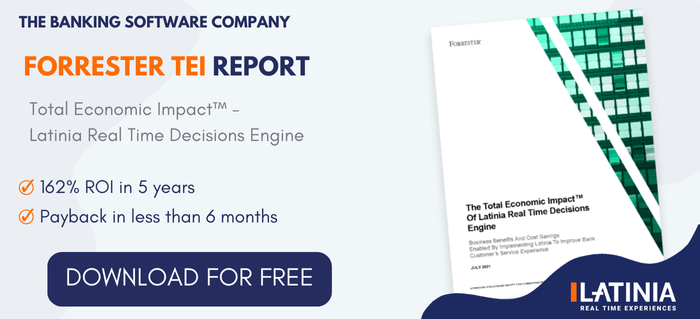
The Forrester Total Economic Impact™ (TEI) study published by Latinia reports a 162% ROI and a payback period of less than six months in the scenario analyzed. These results illustrate the potential economic impact of the technology evaluated, but they shouldn’t be read as a guaranteed return for every institution or configuration.
Hyper-specialized in financial services
Latinia focuses exclusively on the financial industry, so its products are built around the specific needs of banks. This hyper-specialization allows Latinia to offer tools designed to handle the complexities of financial services, enabling more accurate and relevant customer communications.
20 years of industry experience
With more than two decades of experience, Latinia has a deep understanding of the challenges traditional banks face when competing with digital players. Latinia’s expertise, combined with its technology, helps banks optimize customer experiences through personalized, real-time communication strategies that drive engagement and retention.
Conclusion
In a digital world, banks must adapt to meet their customers’ ever-evolving expectations. Competing is no longer just about having a digital presence. It’s about operating with greater agility, making better use of data, personalizing the customer relationship and responding in real time when the context calls for it.
Along the way, Latinia’s software enables banks to make decisions about real-time communications, manage preferences and activate business initiatives when the context warrants it. A digital banking strategy that connects processes, data and relevant communications can help banks compete while preserving their customers’ trust.
Ready to transform how your bank engages with customers? Get in touch with us today to find out how Latinia can help you stay ahead in the digital age.
Frequently Asked Questions
How can traditional banks compete with fintechs?
Traditional banks can compete with fintechs by combining their strengths (trust, customer knowledge and operational capacity) with agile digital services. To do that, they need to simplify processes, make the most of their data and improve the experience. One key differentiator is responding to relevant events with timely communications, rather than simply moving existing services into an app.
What should a digital strategy for financial services include?
A digital strategy for financial services should start from customer needs and the bank’s operational bottlenecks. Its core components include process modernization, connected data and systems, personalization and real-time decision-making. It also needs clear priorities and KPIs to assess whether those investments are improving service and competitiveness.
What role do real-time communications play in a digital banking strategy?
Real-time communications let banks act when a significant event occurs, such as a transaction that needs confirmation or a service need. Their value depends on choosing the right information, respecting context and avoiding unnecessary messages. That’s why they complement channel digitalization: they help the bank stay meaningfully connected with customers even outside its app.