
Key Trends Shaping the Future Agenda
The relationship between banks and customers is undergoing the biggest transformation in decades. Digitalisation, new regulations, and more demanding consumers are redefining what counts as a “good banking experience.”
Looking ahead to 2026, expectations indicate that speed, personalisation, and trust will no longer be differentiators but baseline conditions of banking services.
This article summarises the main trends that, in our view, will shape banking customer expectations and their translation into the strategic agenda of financial institutions.
Three Major Forces Redefining the Bank–Customer Relationship
1. Full Digitalisation: From Channels to Experience
The 2026 banking customer will be, above all, digital. Mobile and online banking have shifted from being alternative channels to becoming the primary way customers interact with their bank. Branches still matter, but they are no longer at the centre of the experience.
“The balancing act: Omnichannel excellence in retail banking” concludes that around 80% of customer touchpoints are already digital. – McKinsey
For most customers, operating “normally” now means:
- Managing financial products on mobile 24/7. (Banking Consumer Study 2025, Accenture).
- Instantaneity as the minimum quality threshold.
- Penalising any delay as a service failure.
- Expecting paperless, low-friction processes with no physical displacement.
- Resolving issues at the speed of a chat or digital assistant.
Comparison benchmarks are no longer just other banks but the major digital platforms customers use every day.
2. Regulation Empowering the Customer
2.1 Europe: PSD3, PSR and FIDA as Open Finance Enablers
From 2026 onwards, the EU will adopt the PSD3 package, consisting of the new Payment Services Regulation (PSR) and the proposed FIDA (Financial Data Access) framework.
While customer expectations push change from the demand side, European regulation removes excuses from the supply side:
- More rights over personal data and greater ability to port it across providers.
- Stricter rules on automated decisions, transparency, and creditworthiness assessments.
- Increasing requirements in cybersecurity and operational continuity.
For customers, this translates into more control and more choice. For banks, it creates simultaneous pressure to innovate in Open Banking/Open Finance and ensure compliance.
The outcome: better informed customers, better protected, and facing lower switching costs between institutions.
2.2 Latin America: An Accelerated Open Finance Laboratory
Latin America has become one of the most active Open Finance laboratories, with diverse approaches but a shared pattern: using data openness to drive financial inclusion and competition.
This means enabling users to share their information across institutions to access credit, alternative scoring, aggregated services, and a wider set of products — reducing barriers and strengthening ecosystem diversity.
Mexico laid the foundations with its 2018 Fintech Law, introducing the concept of standardised APIs for financial data.
Colombia, Chile, and Peru have approved or are discussing their own Open Finance/Open Data frameworks (e.g., Colombia’s 2022 Open Finance decree with phases for payment initiation services and data aggregation), seeking interoperable models adapted to local realities.
Changing Values: From a “Bank That Operates” to a “Bank That Accompanies”
Customers no longer just want banks to execute transactions; they expect them to help make better financial decisions and operate coherently with certain values (sustainability, social impact, ethical data use, etc.).
This translates into expectations of:
- Financial guidance (alerts, recommendations, education, etc.).
- Greater transparency around fees and risks.
- Coherence between institutional discourse and lending/investment policies.
Five Key Customer Expectations for 2026
1. Genuine, Frictionless Omnichannel Experiences
It’s no longer enough to “be present” in multiple channels. Customers expect them to operate as a single, fluid experience:
- Starting a process on the web and continuing in-app or at the branch without repeating information.
- Call centres having context from digital interactions.
- Campaigns and messages consistent across mobile, web, and physical channels.
Omnichannel is shifting from a technology project to a core pillar of customer experience.
2. Instantaneity as Standard
The “instant economy” is shaping banking operations:
- Real-time payments and transfers.
- Near-instant onboarding and product activation.
- Critical alerts and notifications at the moment the event occurs — not hours later.
Tolerance for slow processes is rapidly shrinking. Anything not fast is perceived as a service failure.
3. Personalisation and Proactivity
Customers want banks to:
- Understand their context and avoid generic messaging.
- Anticipate needs (prevent overdrafts, suggest savings, identify product improvements, etc.).
- Provide actionable recommendations, not just information.
Advanced analytics and AI enable a shift from “broad segments” to granular personalisation.
The challenge is doing so meaningfully, respecting privacy, and delivering tangible value.
To achieve this, institutions need solutions that combine real-time event analysis with hybrid AI, enabling rules, contextual criteria, and explainability without compromising compliance or traceability.
4. Transparency, Security, and Data Control
Trust is built on three pillars:
- Transparency: clear conditions, no opaque fine print, understandable explanations of risks and automated decisions.
- Security: protection against fraud, cyberattacks, and operational errors, with the ability to respond when issues arise.
- Control: customers decide which data to share, with whom, and for what purpose — and can revoke consent easily.

EXPERT TIP
Surveys and analyses on Open Banking highlight that consumers will only share their data if they trust it is secure and under their control, and that trust is critical for the ecosystem to grow.
5. Sustainability and Purpose
For a growing number of customers — especially younger and urban segments — the ideal bank:
- Reduces its own environmental footprint.
- Avoids financing activities clearly against ESG criteria.
- Offers products enabling positive-impact investment and savings.
In 2025, more than 50% of customers value sustainable finance. It is not always the main decision factor, but it does influence brand perception and mid-term loyalty. – KPMG
How do these learnings translate into the banking agenda?
From these trends, a concrete agenda emerges for institutions heading into 2026:
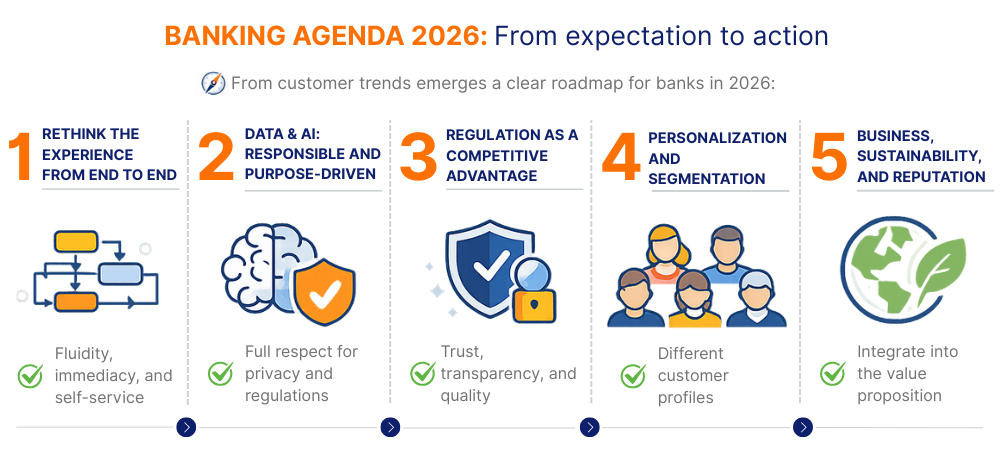
- Rebuild the End-to-End Experience: Not simply adding channels, but redesigning end-to-end processes around fluidity, instantaneity, and self-service.
- Use Data and AI with Purpose and Responsibility: Personalisation should deliver real value (better financial health, time savings, risk reduction…), with full respect for privacy and regulation.
- Turn Regulation into Competitive Advantage: Open Finance, data protection, credit rules and operational resilience can be treated as a cost — or as an opportunity to reinforce trust, transparency, and service quality.
- Segment and Adapt the Value Proposition: Gen Z, millennials, Gen X, and boomers do not expect the same things. Product, communication, and service strategies should reflect these differences without losing overall coherence.
- Align Business, Sustainability, and Reputation: The ESG agenda is no longer an isolated CSR chapter but part of the core value proposition: what is financed, what is offered, and how it is communicated.
Conclusion: More Power on the Customer Side
From 2026 onward — and for years to come — the power balance between banks and customers will be very different from a decade ago. The combination of technology, regulation, and new sensitivities has created an environment where switching providers is easier, comparing options is simpler, and demanding better services is more natural.
Institutions that anticipate these expectations — offering frictionless digital experiences, real-time service, useful personalisation, maximum transparency, and a clear purpose — will be at an advantage.
Those that merely digitise existing processes, without rethinking the customer relationship, will see their relevance diminish.
The question is no longer whether banking customers will be more demanding in 2026, but rather how far ahead each bank will move to meet that reality.