Banks today have more data, more channels and more automation capabilities than ever before. But that alone doesn’t guarantee more personal banking experiences, more relevant communications, or that those communications arrive at the right moment. The real challenge is understanding what is happening with each customer and deciding which action makes sense and when it should happen.
Relevance is about whether a communication makes sense for that customer; timeliness is about whether it makes sense to send it now. Both depend on context, priority and timing, and both require accepting that not every interaction needs to be commercial, and not every event should trigger a communication.
KEY TAKEAWAYS
- Relevance isn’t just about personalizing the message. It’s about deciding whether the communication makes sense for that customer at that moment.
- Banking events and customer data make it possible to put communications in context, going beyond segments and campaign calendars.
- Prioritizing means choosing between different possible actions and, when appropriate, waiting or not communicating at all.
- Customer preferences and contact pressure must be part of the decision.
- A decision based on business rules and executed in real time brings communication closer to the moment when it can add value, and makes it possible to explain why it was triggered or discarded.
What makes a banking communication relevant and timely
Traditionally, much of banking communication has been organized around campaigns: a target audience is identified, a message is prepared and its distribution is scheduled.
This approach is still useful in many scenarios, but it falls short when the goal is to respond to each customer’s individual context.
Take, for example, three customers with similar profiles, all of whom the bank could offer the same product:
- one has just taken it out through another channel
- another has shown interest several times over the past few days
- a third has just experienced an issue that hasn’t been resolved yet
All three could belong to the same segment. Yet it wouldn’t make sense to treat them the same way or at the same moment.
Relevance answers the question: does this communication make sense for this customer? Timeliness adds a second one: does it make sense to communicate it now?
That’s why improving banking communications means going beyond static segmentation and taking into account up-to-date information on the customer’s behavior, transactions and context.
It also means accepting that a relevant interaction doesn’t have to be commercial. It can mean informing, anticipating a need, making a task easier, warning about a situation, or simply avoiding an unnecessary touchpoint.
Why banking communications lose relevance
Relevance tends to slip when a bank has data, campaigns and automation in place, but can’t combine them with enough context to decide which interaction makes sense and when.
The most common causes are:
- messages that are too generic and barely change based on the customer’s situation
- a lack of current context, even when there’s plenty of historical data
- communications that arrive outside the window in which they could add value
- decisions driven by the campaign in progress rather than by the customer’s actual situation
- too many touchpoints, with no regard for the accumulated contact pressure
So the problem isn’t only about content. It also affects timing, priority and the ability to decide when not to communicate.
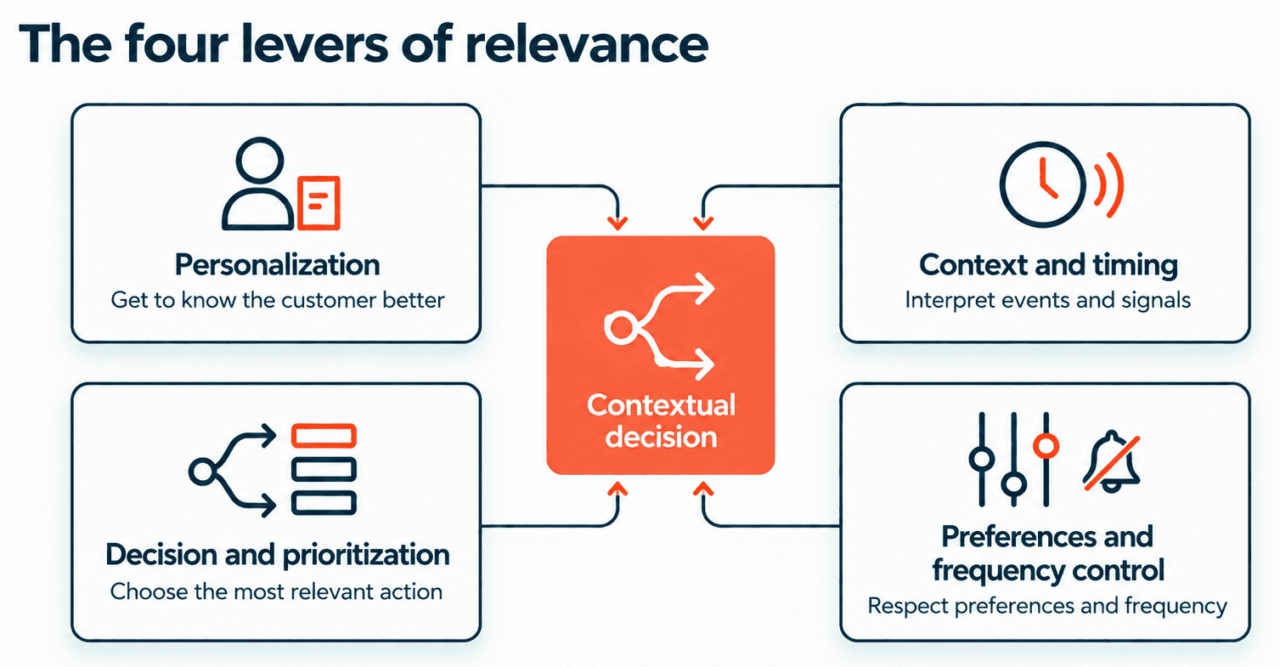
The four levers for making banking communications more relevant
Although many capabilities come into play, much of the problem can be organized around four main levers:
- Understanding the customer better and personalizing the interaction.
- Detecting context, events and timing.
- Deciding and prioritizing which action or communication makes the most sense.
- Managing customer preferences and controlling frequency and contact pressure.
These capabilities are closely linked. The better a bank knows its customers, the more context it can bring into its decisions. The more signals it can interpret in real time, the better it can determine which action makes sense and how to prioritize it. And the better it aligns those decisions with each customer’s preferences and contact pressure, the easier it becomes to avoid unnecessary, redundant or conflicting touchpoints.
Personalization: tailoring communication to the customer
Segmentation divides the customer base into groups with shared characteristics. It’s an essential first step to avoid completely undifferentiated communication.
Personalization and hyper-personalization take this approach further: they use data on the customer, their behavior and their context to progressively tailor the interaction.
Identifying a group of customers who might be interested in financing is not the same as determining whether a specific offer makes sense for a particular person at that moment.
That knowledge is still useful, but relevance increases when the bank brings in recent signals and can make decisions at an increasingly individual level.
This need to move toward more personalized experiences is also reflected in Capgemini’s World Retail Banking Report 2025, which links personalized communication and real-time support to higher customer engagement.
Context and timing: responding to relevant events
Banking activity continuously generates specific events: a card purchase, a transfer, a deposit or a transaction on an account. Each one can provide a useful signal for assessing whether to inform the customer or trigger another interaction. The point isn’t to react automatically to everything that happens, but to interpret each event using the right criteria.
Real-time personalization of banking communications makes it possible to use those signals to tailor the interaction to each customer’s moment and context, moving away from the logic of traditional campaigns.
Real-time transactional data is especially valuable because it brings the decision closer to the moment the customer’s activity takes place.
For example, when a transaction exceeds the amount set by the customer, the bank can trigger a personalized alert; when an event meets certain security conditions, it can apply a corporate notification rule. In other cases, the transactional context can reveal an opportunity for service or loyalty. Real-time communication becomes valuable when the decision is made while the event is still meaningful.
Location can also help a communication arrive at the right moment. For example, the bank can let a customer know about a benefit available at a nearby merchant when that offer is useful to them.
This logic paves the way toward more proactive banking: shifting from waiting for customers to express a need to recognizing specific contexts in which the bank can anticipate based on real-time signals and context. That doesn’t mean reacting to every event. Strong decisioning capabilities should distinguish between signals that justify an action and those that don’t require any communication.
Deciding and prioritizing which action makes the most sense
When several communications are possible, the bank needs rules to determine which events should trigger a notification, under what conditions, with what priority and for which recipient.
In commercial or loyalty contexts, another question also comes into play: identifying the right moment to activate an initiative the business has already defined. Both decisions contribute to relevance, but they address different needs.
Depending on the context, the response may be to:
- inform
- help complete a task
- recommend
- present an offer
- prioritize one communication over another
- wait or not communicate
Prioritizing doesn’t mean always finding a communication to send. If another touchpoint would add little value or increase pressure on the customer, postponing it or not communicating may also be the right decision.
In operational, transactional or security communications, the decision focuses on applying the rules defined by the bank. For commercial, service or loyalty initiatives, Next Best Action focuses on the when: the business defines the offer or action, and technology identifies, based on the event and a specific customer’s context, the right moment to activate it. It isn’t the same as automatically selecting from among all possible offers.
How to avoid communication overload
Overload occurs when communications that might be reasonable on their own compete with each other for the same customer’s attention. Avoiding it requires coordinating interactions and taking into account both their importance and the recipient’s preferences.
To control contact pressure, the bank can:
- keep track of recent interactions
- respect preferences, subscriptions, channels and thresholds
- set frequency caps where appropriate
- prioritize the most important communications
- postpone or suppress touchpoints that add little value or conflict with others
Not all communications are of the same nature: a customer preference shouldn’t block a critical or mandatory alert when that alert needs to take precedence. Managing that distinction well is part of truly relevant communication.
From data to decision to communication
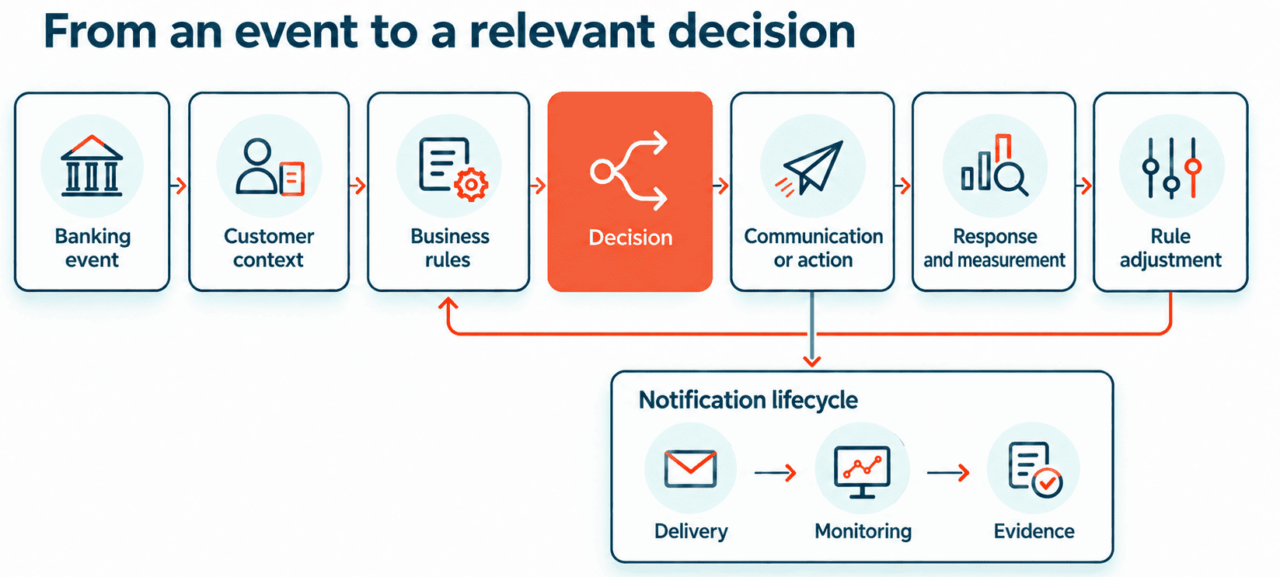
The value of a banking communication starts before it’s sent. When an event occurs, the bank can interpret it in light of the customer’s context and preferences, apply its business rules and decide whether it makes sense to communicate something at that moment. The interaction then takes place, and its results help assess its usefulness and improve future decisions.
-
- Banking event. The starting point is an identifiable event in banking activity, usually transactional, evaluated individually and in real time.
- Customer context. Information about the customer, their products, subscriptions and touchpoints makes it possible to interpret the event rather than treating it as an isolated data point.
- Business rules and decision. Rules configured by the bank, or by the customer within the enabled services, determine whether to notify, whom, under what conditions and when. The decision must be explainable, including when the event is discarded and no communication is generated.
- Communication or action. If action is warranted, the decision triggers a notification or a service, commercial or loyalty initiative suited to the event and its context. If not, there may be no touchpoint at all.
- Response and measurement. The interaction is assessed on whether it served its purpose: information acknowledged, task completed, engagement, customer response or conversion, where there’s a commercial goal.
- Analysis and improvement. Decision analytics and interaction results help review conditions, priorities and rules. Here, “improvement” doesn’t mean the engine changes the rules automatically: the teams responsible can analyze, test and adjust what has been configured.
How to measure whether communications are truly more relevant
There’s no single metric that can measure relevance. How it’s assessed will depend on the goal of each interaction, but it’s best not to limit it to volume metrics or immediate commercial results.
Useful indicators include effective engagement, completed actions, satisfaction, unsubscribes or opt-outs, complaints, contact pressure and the time between event and response. Where there’s a commercial goal, conversion is also worth tracking. In rule-based systems, it’s also worth examining which events generated notifications, which were discarded and why: this analysis helps refine decision criteria without confusing volume with relevance.
Profitability can be a result of more relevant communication, but it shouldn’t be the only criterion. An interaction designed to prevent an issue or make a task easier can add value without leading to an immediate commercial conversion.
How Latinia helps make more relevant decisions
Latinia helps banks decide what to communicate, to whom and when, based on each customer’s transactions and context. Its Decision-Centric Banking approach is about making that decision before the message is sent, in order to deliver more useful information and offers and avoid unnecessary touchpoints.
Real-Time Decisioning engines: deciding what to notify
Latinia’s Real-Time Decisioning engines analyze banking events in real time and apply the rules defined by the bank or its customers’ preferences. This is how they decide when to send a communication and when it’s better not to.
Within this family, each engine addresses a different need:
- RTD Universal: the bank decides.
RTD Universal lets the bank decide which transactions should trigger alerts (for example, about account activity, security or incidents) and under what conditions. This avoids unnecessary notifications. To learn more about this capability, see Latinia’s Real-Time Decision Engine.
- RTD Subscription: the customer decides.
RTD Subscription lets each customer choose the alerts they want to receive from the options offered by the bank: for example, for which accounts or cards, above what amount and through which channel. This way, notifications are better aligned with their preferences.
- RTD Next Best Action: the business decides the moment.
RTD Next Best Action identifies the right moment to present the customer with a commercial, service or loyalty offer based on their transactions and context. The bank defines the initiative; Latinia helps activate it when it’s likely to be useful and avoid excessive touchpoints.
- Geolocation: the value of being in the right place.
Geolocation adds place to the context of the communication. For example, a bank can let a customer know about a discount at a nearby merchant right when they’re close by and can take advantage of it.
Critical Alerts Gateway: turning the decision into reliable delivery
The Critical Alerts Gateway helps ensure communications are delivered reliably, even when multiple channels and providers are involved. It makes it possible to set priorities, manage incidents and track the status of each notification.
It covers four areas:
- Composition and personalization. It builds the notification using templates and data from the event and the recipient.
- Prioritization and delivery. It applies priority policies and coordinates channels and providers according to the type of communication.
- Service continuity. It handles incidents through retries and channel and provider failover or substitution mechanisms.
- Traceability and evidence. It records the lifecycle of each notification for monitoring and, where applicable, audit and compliance.
Altogether, Latinia helps banks make better choices about what to communicate and when, and deliver alerts reliably. These decisions can also improve profitability and customer experience by offering services and benefits better suited to each moment.
FAQs
What makes a banking communication relevant?
A banking communication is relevant when it responds to a real need, situation or interest on the customer’s part. To determine this, the bank can combine information about the customer’s profile, behavior, recent transactions, context and preferences. Personalizing the content matters, but so do the decision to communicate and the timing.
How can a bank choose the right moment to communicate with a customer?
It can rely on individual banking events, interpreted using customer data and business rules in real time. Timeliness isn’t about always sending as soon as possible, but about deciding whether that event warrants a communication and, where applicable, whether the planned initiative is relevant at that exact moment.
How can banking communication overload be avoided?
It requires coordinating the different interactions, taking customer preferences into account and knowing the accumulated contact pressure. This makes it possible to set priorities, frequency caps and exclusion rules, as well as cancel or postpone communications when another action is more important.
What technologies help make banking communications more relevant?
A business rules engine specialized in banking can decide in real time which events should be notified, to whom, when and under what conditions, while also logging the events it discards. Subscription-based personalization makes it possible to incorporate customer preferences; Next Best Action is used to activate business initiatives at the right moment. Another technology layer builds, delivers and monitors the notification.