
Latin America’s major financial events of 2026 converged on one clear takeaway: banking innovation has to deliver tangible results. Agentic AI, instant payments, open finance and security dominated the conversation in a year when execution, governance and trust became the sector’s top priorities.
Introduction
In 2025, financial events across Latin America revolved around a single idea: moving from promise to real adoption. In 2026, the question changed. Nobody is debating anymore whether AI, instant payments or open finance will reach the region’s banks. The debate is about who rolls them out, on what infrastructure and under which rules.
The sector’s flagship forums returned to the same themes from one country to the next, but with a new angle: the focus was no longer on what technology exists, but on the operational capability needed to use it safely.
In this article, we review the key takeaways from 2026’s financial events and look at how banking priorities are shifting across Latin America.
Key highlights
- Agentic AI dominated the conversation, with a shared message: more autonomy, always under human oversight.
- Instant payments are now treated as critical infrastructure; the debate is over who governs those rails and how they are protected.
- Open finance already has a regulatory framework in several countries; the challenge now is implementation and earning user trust.
- Security became the starting point for innovation rather than an afterthought.
- Fintechs and banks are now competing for lending, business clients and the real economy.
Financial events 2026: the year’s key gatherings
- Fintech Americas 2026 | March 24-26 | Miami Beach, United States. The 12th edition, now part of Money20/20, was built around “the fourth dimension: AI with soul”: how to harness AI without losing the human touch that builds trust.
- Chile Fintech Forum 2026 | May 6-7 | Santiago, Chile. The sixth edition launched FinteChile and EY’s 2026 Chile Fintech Map, which counts 540 fintechs operating in the country, with average annual growth of 17% between 2020 and 2026.
- Open Finance 2050 | July 21-22 | Mexico City. The eighth edition, which coincided with the eighth anniversary of Mexico’s Fintech Law, focused on the arrival of digital banks and collaboration between banks and fintechs.
- 60th Asobancaria Banking Convention | August 26-28 | Cartagena, Colombia. Colombian banking’s flagship event closed with a proposed public-private program to bring 5 million adults who currently rely on informal lending into the formal credit system.
- Latam Fintech Market 2026 | September 17-18 | Barranquilla, Colombia. The eighth edition, hosted by Colombia Fintech, centered on open finance, instant payment governance and the use of AI in lending.
- FINNOSUMMIT 2026 | September 23-24 | Mexico City. The 10th edition drew more than 2,000 attendees and concluded that financial technology is looking to plug directly into productive sectors.
- CLAB 26 | October 15-16 | Quito, Ecuador. FELABAN’s technology and innovation congress, co-organized with Asobanca, came to Ecuador for the first time with five core themes, led by security and trust.
- 60th FELABAN Annual Assembly | November 3-6 | Lima, Peru. Organized by ASBANC and FELABAN, it opened with a clear message: security must go hand in hand with innovation from the very start.
From 2025 to 2026: how the agenda has shifted
Compared with 2025, the 2026 agenda changed in focus more than in subject matter: the same themes came back, but the conversation moved from promise to implementation. Here’s how it stacks up against last year’s review:
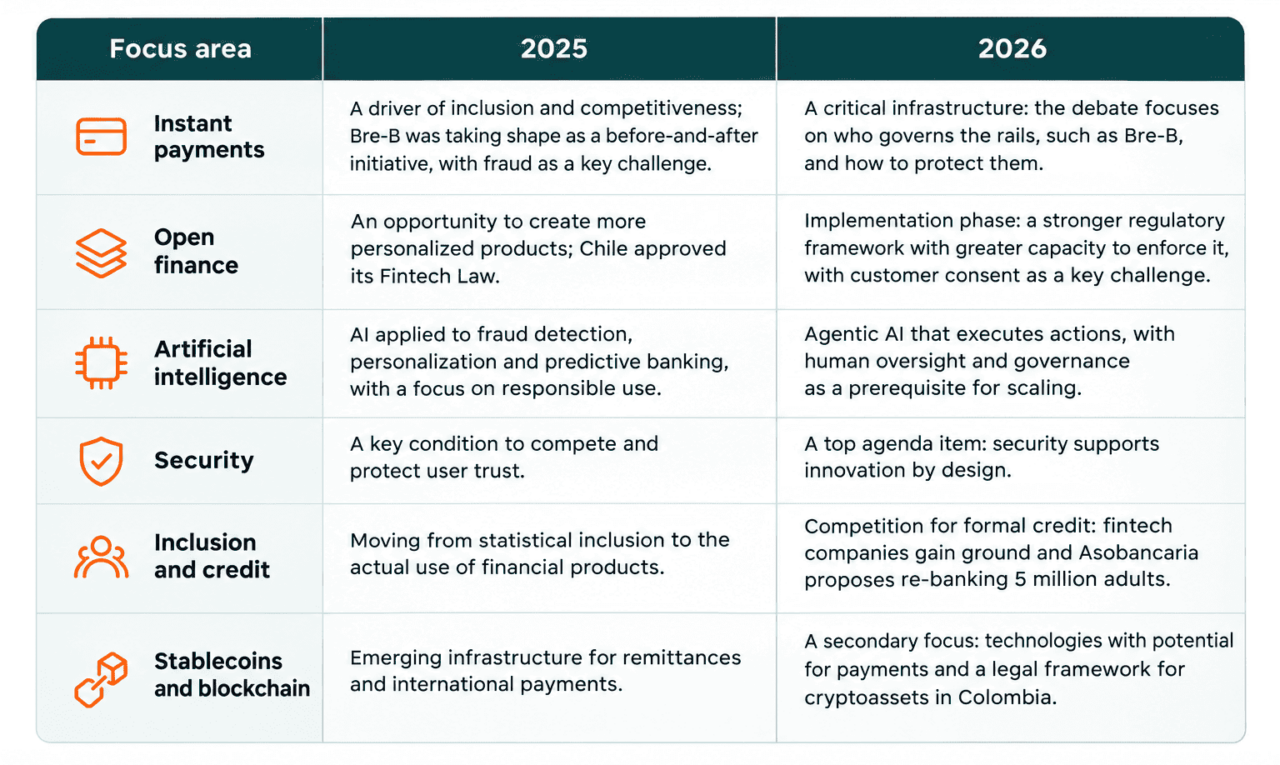
The two clearest changes are security rising to the top of the agenda and the leap from AI that assists to AI that acts.
Agentic AI: more autonomy, with humans in charge
If one theme cut across 2026, it was agentic AI: systems that don’t just respond, but pursue a goal and take action to achieve it. Fintech Americas kicked off the year with a tagline that sums up the debate, “the fourth dimension: AI with soul”, and dedicated sessions to responsible AI implementation. The underlying question was how to unlock its potential without losing the human touch that builds trust.
The numbers show adoption is already widespread. In Mexico, FINNOSUMMIT shared figures from the Finnovista Fintech Radar 2026: 77% of the country’s fintechs already use AI in their operations.
In Barranquilla, the spotlight was on accountability. Latam Fintech Market made room for accountability in automated decision-making, with panels on credit algorithms and digital identity. For banks, the implication is clear: every decision an agent makes will need to be explainable, auditable and communicated to the customer.
Instant payments: from adoption to infrastructure governance
Instant payments are no longer pitched as something new; they are now treated as critical infrastructure. In Colombia, one of Latam Fintech Market’s core themes was the ownership and governance of instant payment infrastructure such as Bre-B. At the opening session, Colombia Fintech urged the government to strengthen Bre-B, with measures such as lifting its transaction caps or routing government payments through it.
Security ran through the entire conversation. At FINNOSUMMIT, the discussion on cross-border payments zeroed in on security, transparency and fraud prevention as instant payments keep growing. The logic is familiar: the faster money moves, the less time there is to spot a suspicious transaction and alert the customer.
Open finance: the rules are ready, execution is lagging
Chile captured where the region stands. At the Chile Fintech Forum, FinteChile’s president warned that, with the Fintech Law and the CMF’s NCG 514, the country has more regulation in place than capacity to implement it.
The challenge isn’t just technical. Rolling out open finance requires financial institutions to manage user consent securely and with full traceability. In Mexico, Open Finance 2050 brought together banking and fintech leaders to tackle the challenges of transforming financial services.
Colombia is in a similar position. At Latam Fintech Market, the panel “Open Finance, Closed Doors: What Colombia Is Still Missing” addressed the gaps still holding back open finance in the country.
EXPERT TIP
We break down where each market stands in our open finance regulatory map for LATAM. For banks, every consent a customer grants, changes or revokes is an event that calls for immediate, traceable communication.
Security: the starting point for innovation
In 2026, security moved from the bottom of the list to the top. Security and Trust was one of CLAB 26’s five core themes, with a focus on emerging risks, systemic resilience and digital trust. In Lima, ASBANC president Martín Naranjo summed it up at the opening of the 2026 FELABAN Assembly: “Security has to go hand in hand with innovation from the moment it is conceived.”
Mexico reached the same diagnosis. At Open Finance 2050, fraud, digital identity and financial literacy were singled out as key challenges to strengthening trust in the financial ecosystem. In Chile, the new Personal Data Protection Law introduces new requirements for how data is processed and protected, while CMF regulations tighten authentication requirements for electronic transactions.
In practice, a fraud alert, a transaction confirmation or an authentication request has to arrive instantly, through the right channel and with proof of delivery.
A resilient communications architecture makes all the difference, as we explain in our guide to operational resilience and service continuity.
Fintechs and banks move into the real economy
The year’s fourth big shift was about where the action is. At FINNOSUMMIT, the talk was about embedding financial solutions into sectors such as retail, logistics, healthcare and supply chains. Collaboration with banks is also gaining ground: 80% of Mexican fintechs already partner or are in the process of partnering with banks.
In Mexico, the competition has names. Open Finance 2050 devoted much of its agenda to the “digital banking World Cup” playing out in the country, with Nu, Revolut and Mercado Pago as the main contenders, and to bank-fintech collaboration as a way to deliver more value to customers.
In Colombia, the battle shifted to business banking and lending. According to El Tiempo, digital platforms are now going after business that has traditionally belonged to banks, such as lending, deposits, corporate treasury, factoring and payroll. The most telling figure: between January and July, fintechs originated 5.2 million of the 7.5 million loans backed by the FGA guarantee fund, or 70% of the total.
Traditional banks made their move too. At the close of the 60th Banking Convention, Asobancaria’s president proposed a public-private program to bring 5 million adults back into the banking system in the short term. The goal is to raise the share of Colombian adults with formal credit from 51.6% to 75% and curb informal loan-sharking, known locally as “gota a gota”. One of the proposals is to review how the usury rate cap is calculated.
What 2026’s financial events mean for banks
This year’s forums agreed on something deeper than a list of trends. Agentic AI, instant payments, open finance and security share a common requirement: every event they trigger, whether a payment, a consent, an automated decision or a risk signal, needs an immediate, consistent and traceable response.
EXPERT TIP
Before launching an agentic AI or instant payments use case, map out the events it will generate: confirmations, consents, fraud alerts and automated decisions. For each one, define who decides whether it gets communicated, through which channel and with what evidence. Without that layer in place, your pilot will scale risk faster than value.
That decision layer is what separates announced innovation from delivered innovation. A Universal RTD Engine makes it possible to decide in real time what to communicate to each customer and when, based on transactional events. The Critical Alerts Gateway ensures that security and compliance communications are delivered with full traceability.
In 2027, the competitive edge won’t come from adopting more technology, but from better governing the decisions that technology sets in motion.
FAQ: financial events 2026
What were the main financial events in Latin America in 2026?
The most notable included Fintech Americas (Miami, March), the Chile Fintech Forum (Santiago, May), Open Finance 2050 (Mexico City, July), Asobancaria’s Banking Convention (Cartagena, August), Latam Fintech Market (Barranquilla, September), FINNOSUMMIT (Mexico City, September), FELABAN’s CLAB 26 (Quito, October) and the 60th FELABAN Annual Assembly (Lima, November).
Which topics shaped the fintech agenda in Latin America in 2026?
Five themes came up again and again. First, agentic AI with human oversight. Next came the governance of instant payment systems such as Bre-B and the implementation of open finance. Rounding out the list were security and digital trust, and the competition between fintechs and banks for lending, business clients and the real economy.
How did the 2026 financial agenda differ from 2025?
In 2025, the forums focused on moving from technological promise to real adoption. In 2026, the conversation moved on to execution: how to implement open finance frameworks that have already been approved, how to govern instant payment rails and how to give AI autonomy while keeping control, traceability and human oversight over its decisions.
What do the takeaways from 2026’s financial events mean for banks?
They mean that competitive advantage depends more on operational capability than on the technology available. Banks need to respond in real time to events such as payments, consents or fraud signals, decide what to communicate in each case and keep a record of every decision. That decision and communication layer is the foundation for scaling AI and open finance securely.
What financial events are coming up in Latin America in 2027?
The major events on the calendar are expected to return: Fintech Americas, the Chile Fintech Forum, Open Finance 2050, Asobancaria’s Banking Convention, Latam Fintech Market, FINNOSUMMIT, CLAB and the FELABAN Assembly. As of November 2026, only Fintech Americas has confirmed its dates: March 16-18, 2027, in Miami Beach. FINNOSUMMIT has already opened its 2027 sponsorship program.