
Banks already know where their customers operate. They know it when a customer withdraws cash at an ATM, pays at a merchant or opens the app. This data is used every day, mainly for defensive purposes: validating a transaction, complying with a regulation or helping customers find a branch.
The opportunity lies in giving it a second use: turning location into context to communicate something useful at the right time and place. In this article, we review how banks use geolocation today, why merchant benefits programs are the best starting point and how NBA Geo works: the geolocation capability of Latinia’s Next Best Action (NBA) engine.
How banks use geolocation today
Geolocation is fully integrated into banking operations. Its most widespread uses share the same goal: to control, to comply or to locate.
- Fraud prevention and security. This is the most established use. The bank compares the device’s location with the customer’s usual patterns or with risk signals. A transaction from an unusual country, access from an atypical location or an inconsistency between devices can trigger additional controls or temporarily stop the transaction.
- Regulatory compliance. In some markets, regulations require banks to record the location of the device used to operate. The clearest case in Latin America is Mexico, where financial institutions must collect and retain the geolocation of the device their customers use to open accounts, take out products or operate remotely, as part of anti-money laundering efforts. The regulatory framework itself conceives this record as one-off, linked to the transaction and subject to customer consent.
- Service location. This is the most visible use for the customer: finding the nearest ATM or branch. It is useful, but reactive: the customer searches and the bank responds.
Outside banking, the use of location to create experiences is much more mature. Proximity marketing and geofencing techniques, which send an offer when a customer enters an area or approaches a specific point, are common in retail and hospitality. In banking, they remain a minority use. That is where the room for growth lies.
From location as control to location as context
The geographic context that banks already capture to protect themselves and to comply can also serve what customers value most: receiving something useful at the right time and place.
That is the approach behind NBA Geo. In Latinia’s logic, an NBA is the ideal moment to deliver content to a specific customer, based on their transactional activity and what the bank knows about them. NBA Geo adds one more dimension to that decision: where the customer is.
Juan withdraws cash at an ATM. A few meters away, there is a restaurant that belongs to his bank’s merchant benefits program. At that moment, he receives: “Hi Juan, it’s 12:30 and there’s a 15% discount 20 meters away if you pay with your card.”
The offer is linked to something Juan has just done with his bank. That is why he perceives it as a response to his moment, rather than an offer that appears out of nowhere while he walks down the street. It is a change in approach rather than in technology: the bank does not need new location-capture capabilities, but a way to turn data it already handles into a valuable experience.
Merchant benefits programs: from forgotten catalog to loyalty engine
Almost every bank has a merchant benefits program: discounts and perks at a network of partner merchants, built through commercial agreements, time and resources. It is the quintessential use case for geolocation, because it is the asset with the most untapped potential.
At most institutions, the program lives separately from the customer’s daily life:
- It sits in a section of the website or in emails the customer rarely opens.
- It works as a world apart, disconnected from day-to-day banking.
- It leaves all the work to the customer: remembering the program exists, checking which merchants take part, verifying validity periods and conditions, and remembering it right at the moment of payment.
The result is a familiar cycle: customers don’t know about the benefits, don’t use them and therefore don’t value them. And because customers don’t use them, the bank doesn’t see them as profitable.
Geolocation reverses this approach. Instead of waiting for the customer to look for the benefit, the benefit appears at the time and place where it is relevant, based on the customer’s own banking activity. With this change, three parties win:
- The customer discovers benefits they would not otherwise have used.
- The partner merchant receives traffic at the moment of consumption.
- The bank gets a return on an underused investment and becomes part of the customer’s everyday life as a useful companion.
How NBA Geo works
NBA Geo is one more condition within Latinia’s NBA engine, which is part of RTD (Real-Time Decision), the family of engines that analyzes each event in real time. When an event arrives with the customer’s location, the decision follows four steps:
- The location arrives. An event provides the customer’s coordinates.
- Proximity assessment. The engine measures the distance between those coordinates and the points of interest (POI) configured in the NBA, for example, the restaurants in the program.
- Selection of the closest ones. It selects the merchants within the defined radius, sorted by distance, up to the configured maximum number.
- Notification. The template builds the message with those merchants and delivers it through the corresponding channel.
If there are no merchants within the radius, the NBA is not triggered and the customer receives no communication.
The coordinates can arrive through several channels. The most direct is the mobile banking app, which, with the customer’s permission, sends their position at moments of use, such as opening the app, logging in or making a query. They can also come from a transaction at one of the bank’s ATMs or branches, whose location is already known. NBA Geo works the same way regardless of the source, so the bank can start with the simplest option and add others later.
The message is also adapted to the channel: an SMS can show the nearest merchant; a push notification, several; and an email, the full list.
From a merchant spreadsheet to a live NBA
Launching an NBA Geo is a process that the business team can complete autonomously:
- Start with the merchant list. All it takes is an Excel file with the name and address of each establishment.
- Geocode. Convert each address into coordinates using a standard geocoding service and generate a KML file, a standard geographic information format.
- Create the class and the group. Define the type of merchant (for example, Restaurants) and the program or chain within it.
- Upload the file to that class and group.
- Create the NBA with the Geo condition, specifying the class, group, radius (between 250 meters and 1 kilometer) and the number of merchants to be notified.
- Evaluate in virtual mode. The NBA is tested on real events without sending any communication, to fine-tune the radius, group or volume.
- Activate.
The first four steps are done only once, and the uploaded locations can be used for every NBA you want to create. The last three are the usual cycle for any NBA.
Use cases: the event suggests what to offer
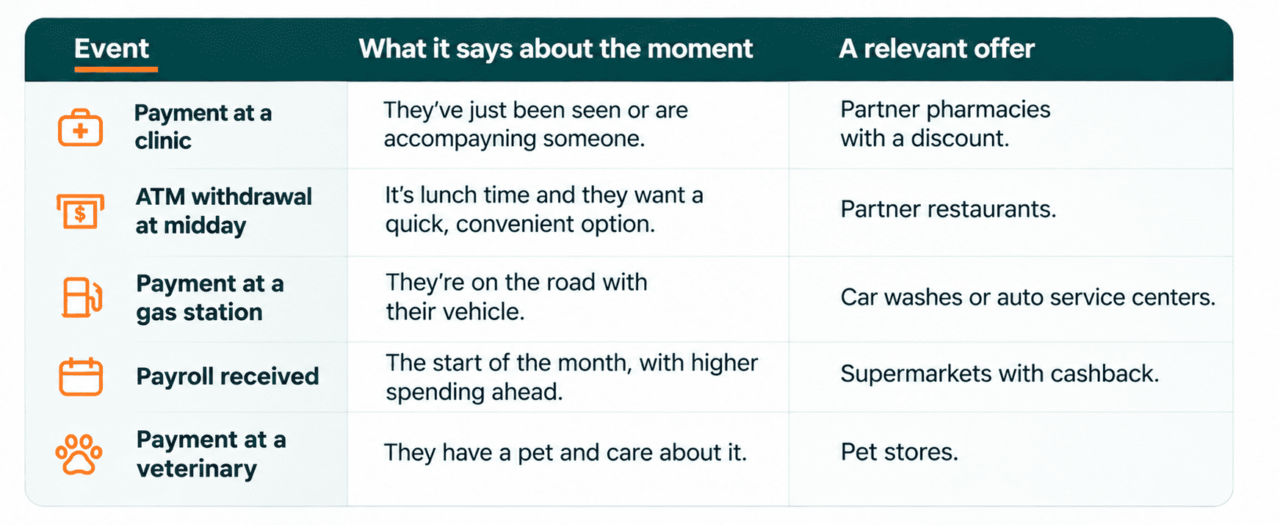
Combining the customer’s transaction with their location makes it possible to tailor the offer to what they are experiencing at that moment. These scenarios are illustrative:
These cases combine two different engine conditions. The merchant condition, based on the MCC (Merchant Category Code, the code that identifies the merchant’s activity in each card payment), indicates where the customer has paid. The Geo condition indicates what is around them.
Beyond merchant programs: service, operations and cross-selling
Location also helps support customers and strengthen the relationship with the bank’s products:
- Welcome abroad: after a purchase in another country, the customer receives the assistance phone number and the option to take out travel insurance.
- Outside their city: after a purchase or withdrawal in another city, the bank shows them the nearest fee-free ATMs in its network.
- Nearest branch: if they check a pre-approved loan in the app, they receive the nearby branch where they can sign it.
- Unused benefit: if they pay by debit card at a merchant in the credit card program, the bank reminds them how much they would have saved with the associated card.
- Closing the loop: if they buy at the suggested merchant, they receive confirmation of the savings obtained, and the bank can measure conversion.
In this way, ATMs and branches are no longer just operational infrastructure and become part of the customer experience.
EXPERT TIP
Not all interactions have the same value for a geolocation strategy. The most effective are those in which the customer is away from home and ready to spend: they have just withdrawn cash, just paid or are opening the app on the street. Limiting location capture to a few daily interactions, chosen for their value, improves the relevance of each offer and protects the customer experience.
Privacy: location as a value exchange
Customers’ concern about feeling tracked is legitimate, and the answer lies in the usage model.
NBA Geo relies on one-off geographic context, linked to the moment of interaction with the bank, rather than on continuous location tracking. Whether or not to share their location is the customer’s decision, managed from their device and from the bank’s app, and they can revoke it at any time. Latinia plays no part in managing that permission: it only uses the location when the bank’s app provides it.
This has a direct consequence: geolocation is only sustainable if it delivers perceived value. If customers receive useful offers, they keep the permission active. That is why the interests of the bank and the customer are aligned.
The engine also includes mechanisms to ensure that proactivity never turns into noise:
- Three-level saturation control (per NBA, per transaction type and globally per customer), to limit how many times the same customer is contacted, even if the app sends many locations.
- Time slots, so that each offer is only triggered when it makes sense (for example, restaurants at lunchtime).
- Stated preferences, so that customers themselves indicate what type of benefits they want to receive. The offer is only triggered if it matches their choice.
What geolocation brings to each area of the bank
- Digital channels: greater impact for every notification, because it arrives at the moment of the customer’s highest attention, right after a transaction.
- Marketing and loyalty: benefit activation at the point and moment of consumption.
- Business and strategy: differentiation in a market where products and apps look increasingly alike.
- Distribution network: new uses for ATMs, branches and points of service.
- Compliance and privacy: a model based on one-off context and consent.
All of this is built on three assets the bank already has: its transactional activity, its network of partner merchants and its knowledge of its customers.
Frequently asked questions about geolocation and customer loyalty
What is NBA Geo?
NBA Geo is the geolocation capability of Latinia’s Next Best Action engine. It allows an NBA to take into account where the customer is: based on their location, it identifies nearby points of interest, such as partner merchants, ATMs or branches, and generates an offer that is relevant to that place and moment. It is not a standalone product, but one more condition within the NBA decision logic.
Does banking geolocation involve tracking customers continuously?
Not in the NBA Geo model. Location is used on a one-off basis, linked to the moment the customer interacts with the bank, and always with their consent, which they manage from their device and from their bank’s app and can revoke at any time.
Where does the bank get the customer’s location to send geolocated offers?
The most common source is the mobile banking app, which, with the customer’s permission, sends their position at moments of use such as logging in or making a query. The location can also come from a transaction at one of the bank’s ATMs or branches, whose position is already known. NBA Geo works the same way with any of these sources.
What does a bank need to add geolocation to its merchant benefits program?
The starting point is a list of partner merchants with their names and addresses. These addresses are converted into coordinates using a standard geocoding service, uploaded to the product organized by merchant type and program, and used in an NBA with a geolocation condition. Before activation, the NBA can be evaluated in virtual mode on real events, without sending any communication to customers.
How do you avoid overwhelming customers with location-based offers?
Capturing location and communicating with the customer are two separate decisions. Even if the app sends several locations a day, communication frequency is controlled by the engine’s saturation settings, which limit contacts per NBA, per transaction type and in total per customer. Time slots and the customer’s own stated preferences add further control.
What is geolocation used for in banking, besides merchant offers?
Besides activating merchant program benefits, geolocation enables service and cross-selling communications: the assistance phone number and travel insurance when the customer operates abroad, the nearest fee-free ATMs when they are outside their city, or the branch where they can sign a pre-approved loan. These uses coexist with the traditional uses of fraud prevention, regulatory compliance and service location.