
In 2025, Latin America has established itself as a key hub for financial innovation. From Santiago to Mexico City, the latest forums and conferences have brought together banks, fintechs, and regulators to discuss inclusion, artificial intelligence, blockchain, and technological modernization.
These gatherings highlight the direction the industry is heading: What debates have shaped the agenda, and which trends are beginning to define the future of banking in the region? In this article, we review the main themes addressed at the most relevant fintech events of the year and how they are shaping the evolution of the Latin American financial ecosystem.
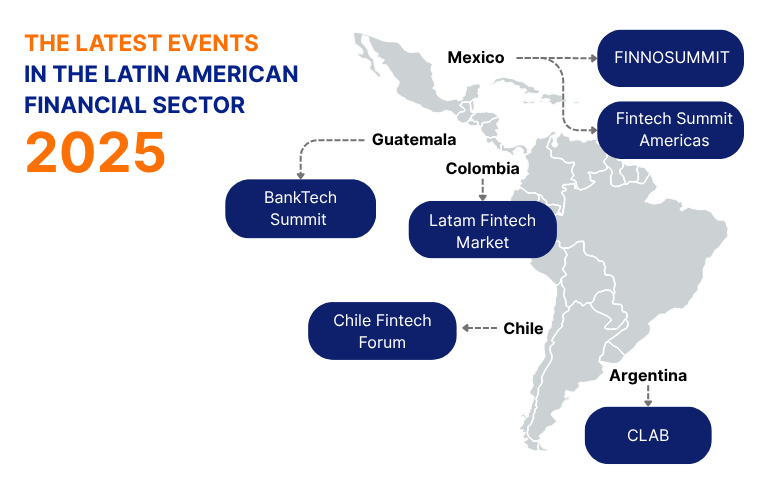
- FINNOSUMMIT 2025 September 24–25th, 2025 | Mexico City. It marked the shift from disruption to consolidation of fintech in Latin America. The event highlighted artificial intelligence, digital and interoperable payments, and the progress of open finance, along with transformative initiatives such as DisruptHer, aimed at boosting female leadership in the region’s fintech ecosystem.
- Latam Fintech Market 2025 September 11–12th, 2025 | Barranquilla, Colombia. Highlighted the role of instant payments with Bre-B, the adoption of artificial intelligence, and the rise of cryptocurrencies within a trusted regulatory framework.
- CLAB 2025 September 10–12th, 2025 | Buenos Aires, Argentina. Addressed the evolution toward predictive banking, invisible finance, and the modernization of core systems to ensure technological resilience.
- Fintech Summit Americas 2025 August 12–13th, 2025 | Mexico City. Focused on blockchain, stablecoins, and open banking as key pillars for transforming remittances and cross-border payments.
- BankTech Summit 2025 July 17–18th, 2025 | Antigua, Guatemala. Centered on the progress of financial digitalization in Central America, with emphasis on credit access, inclusion, and strengthening secure instant payments.
- Chile Fintech Forum 2025 May 13–14th, 2025 | Santiago, Chile. Aimed to analyze how to move from statistical financial inclusion to real adoption of products, along with the impact of the Fintech Law, open finance, and artificial intelligence.
From paradigm shift to the consolidation of the new financial system
The most recent edition of FINNOSUMMIT highlighted that the paradigm shift has given way to a new stage: the consolidation of fintech as pillars of the financial system in Latin America. This change in focus translates into a broader debate on how to build solid, inclusive, and sustainable structures capable of supporting digital growth over the next decade.
Among the key topics, the event spotlighted artificial intelligence applied to financial services, the use of stablecoins and blockchain as drivers of inclusion and efficiency in international payments, and the need to move toward democratizing investment to bring new opportunities in areas such as real estate or financial markets.
The event also served as the launchpad for high-impact initiatives such as DisruptHer, focused on strengthening female leadership through mentorships and specialized panels, and the FINNOSUMMIT Challenge 2025, presented by Banamex, which recognized startups reinventing the future of investments. These initiatives reflect that the fintech agenda is no longer limited to product innovation but seeks to integrate diversity, equity, and strategic collaboration as essential elements of a new financial system.
Within this framework, Oriol Ros, co-founder of Latinia, participated in the session “Mexico and Spain in the Fintech Sector: Challenges and Opportunities”, where the value of ties between both markets was emphasized to strengthen the sector. Mexico, as one of the epicenters of financial innovation in Latin America, and Spain, as a gateway to Europe and a benchmark in sector regulation. The combination of experiences, learnings, and business models from both countries opens opportunities to accelerate the adoption of new technologies, strengthen trust in digital services, and generate a more competitive and inclusive environment.
Next, we take a look at how other forums in Latin America have reinforced these priorities and what trends are beginning to shape the course of the financial sector.
From inclusion to effective adoption of financial products
At gatherings like the Chile Fintech Forum and the BankTech Summit in Guatemala, one idea was strongly emphasized: financial inclusion goes far beyond opening accounts or enabling payment methods.
In Chile, it was noted that access to basic financial products is widespread, but full adoption remains a challenge. According to BCN, more than 85% of the population has a bank account. However, some products still show a wide gap between awareness and actual use: 88% of Chileans are familiar with savings accounts, but only 49% actually use them.
Guatemala, on the other hand, has made progress in recent years. According to the Ministry of Economy, around 65% of the adult population now has a bank account, and access points to the financial system have grown by more than 280% since 2019. These numbers show significant progress, but they also reveal that there is still a way to go.
Another major challenge addressed during the event was ensuring effective access to formal credit. Data shows that its use remains limited—barely 10%—and that many families continue to rely on informal mechanisms to finance themselves.
Ultimately, the challenge is moving from statistical inclusion to effective adoption, making sure that advances in access translate into real, beneficial use of digital financial services.
Instant payments, interoperability, and digitalization
Instant payments were one of the main topics of debate at forums such as the Latam Fintech Market in Colombia and the BankTech Summit in Guatemala. In both spaces, it became clear that the discussion is no longer just about efficiency: immediacy and interoperability of payments are now seen as drivers of inclusion and competitiveness across the region.
In Colombia, the launch of Bre-B is projected as a turning point. Beyond the regulatory context, the country has become a testing ground for measuring how immediacy fosters inclusion, energizes competition, and tackles new fraud challenges.
The challenge is not only ensuring access, but also usefulness. As highlighted in the reports from Latam Fintech Market 2025, although 96.3% of Colombian adults have at least one financial product, the question is how accessible and practical these are in daily life. Bre-B aims to change that with simple, low-cost services capable of reaching historically excluded segments.
In Guatemala, the evolution of instant payment systems has also stood out. The Instant Fund Transfers system (TIF) has shown accelerated growth, with an increase of nearly 101% in recent years. This dynamism reflects that users are not only looking for speed, but also reliability and availability in their daily transactions.
But immediacy also brings risks. Global experiences confirm that as instant payments grow, fraud attempts rise at the same pace. In systems where transaction reversals are not contemplated, such as Bre-B, real-time prevention becomes essential.
At this stage, customer trust becomes the most valuable asset. Our Chief Commercial Officer, Juliana Ortiz, reaffirmed this in her interview with DF SUD, highlighting the importance of communicating with bank customers in real time: “Instant payments cannot be understood without real-time notifications that allow users to confirm every transaction and strengthen the system’s credibility.”
Regulation and Open Finance
In Chile, the approval of the Fintech Law marks a turning point. For the first time, new financial players are explicitly recognized, establishing a legal framework aimed at building market confidence. The key, however, lies in its implementation: it must be proportional, ensuring oversight without stifling innovation.
This idea wasn’t limited to Santiago. In other forums across the region, there was also a strong emphasis that regulation can become a true enabler of innovation—provided it is designed with a forward-looking approach. If applied too rigidly, it risks slowing down competition and limiting the ability of banks and fintechs to adapt to changing times.
Within this context, open finance was presented as a major opportunity—a model that enables data sharing with consent and opens the door to more personalized products—at forums such as:
- Chile Fintech Forum – The Future of Connected Finance in Latin America
- BankTech Summit – Approach to a Successful Implementation
The challenge is implementing it with security and trust so that banks and fintechs can turn regulation into a platform for innovation rather than a barrier to growth.
From open finance to invisible finance
At CLAB 2025 in Buenos Aires, the conversation went a step beyond open finance. As highlighted in Banco Provincia’s event report, the debate focused on how the natural evolution of this model leads toward invisible finance, where financial services stop being visible products and instead become seamlessly embedded into everyday life.
In this approach, paying for transportation, making a purchase, or accessing a service is no longer seen as an explicit transaction with the bank but rather as an experience integrated into other platforms.
For financial institutions, the challenge is not only to offer competitive products but to become the digital infrastructure that supports a frictionless ecosystem. This requires modern, resilient systems capable of operating in real time, since users expect everything to happen instantly and transparently.
Cybersecurity, trust, and fraud prevention
Accelerated digitalization has turned cybersecurity from a technical issue into a strategic factor of competitiveness. At the 2025 forums, there was broad agreement that user trust is now the most valuable asset for banks and fintechs—and that it can only be sustained if data protection and fraud prevention are guaranteed in every interaction.
The challenge is no longer just protecting critical infrastructure, but ensuring that every transaction and every digital interaction is perceived as secure.
Real-time critical notifications play a decisive role: fraud alerts, blocked transactions, or authentication requests must be delivered instantly, through the right channel, and with full traceability. To achieve this, institutions need a resilient architecture capable of ensuring delivery and continuity even under adverse conditions.
Artificial intelligence applied to banking and fintechs
From promise to application: artificial intelligence in the financial sector
Artificial intelligence has moved beyond being an aspirational concept to become a technology already integrated into multiple financial processes. At the Chile Fintech Forum 2025, discussions focused on its role in automating operations, early fraud detection, and personalizing the customer experience.
A notable case was Banco Security, which is exploring the use of generative AI to enhance digital service through product recommendations based on user history.
The debate also highlighted the need to approach AI with a responsible vision: it’s not enough to deploy powerful algorithms; transparency in how they work, clear ethical frameworks, and oversight mechanisms are essential to ensure automated decisions align with user protection.
From artificial intelligence to predictive banking
At CLAB in Buenos Aires, the conversation took another step forward: the challenge now is moving toward predictive banking, capable of anticipating needs in real time through advanced analytics.
In this context, Next Best Actions (NBAs) enable banks to evolve from reactive personalization to proactive management. By analyzing transactional data in real time, it becomes possible to anticipate needs and determine the most relevant action for each customer—from a preventive notification to a financial recommendation delivered at the exact right moment.
Artificial intelligence applied to the fintech sector
At Latam Fintech Market, the spotlight was on how artificial intelligence has already become a strategic tool for scaling digital models in the region. Today, it’s not just about automating processes, but about creating value in areas such as early fraud detection, personalization of financial services, and operational optimization.
Data shows that 38% of fintechs in Colombia are already developing their own AI solutions, while an additional 8.2% are in the adoption phase. This level of penetration reflects an ecosystem that sees AI not only as a competitive advantage but as an essential element for scaling and sustaining digital models.
The challenge lies not only in technological capability but in ensuring responsible use: transparency in algorithms, adequate regulatory frameworks, and data protection that strengthens user trust.
Cryptocurrencies, stablecoins, and blockchain
Blockchain and stablecoins as financial infrastructure
At the Fintech Summit Americas in Mexico City, blockchain and stablecoins were presented as pillars of the financial infrastructure of the future.
With blockchain, the discussion focused on its ability to make cross-border payments and services more efficient. In a region where remittances exceed $140 billion annually, lowering costs and reducing transfer times has a direct impact on millions of families. The technology offers transparency and traceability, but it still faces barriers around scalability and integration with traditional banking systems.
Stablecoins emerged as the most immediate bridge toward that borderless infrastructure. Their use is no longer limited to crypto environments: according to Bitso, 45% of stablecoin volume in Latin America is used for treasury, FX, and international payments. Mexico, Brazil, and Colombia are leading this growth, while Chainalysis confirms that more users are choosing them for international transfers due to lower costs and faster speed.
This progress is also reaching the formal financial ecosystem. Neobanks and fintechs in the region are exploring the integration of blockchain-based services—from crypto wallets to hybrid products that combine traditional accounts with stablecoins. The goal is to provide more flexible solutions tailored to users seeking stability and instant access to digital currencies.
A region moving from promise to real adoption
Latin America has moved beyond the exploration phase. This year’s forums revealed a clear consensus: the challenge is no longer talking about innovation, but ensuring that innovation translates into concrete changes that impact people’s lives. Sustainability, trust, and real value for users are becoming the metrics that separate speeches from results.
The conversation is no longer about the potential benefits of financial digitalization, but about how to build an ecosystem capable of sustaining it. That means resilient infrastructure, forward-looking regulation, and business models that address everyday needs—not just promises of efficiency.
Throughout 2025, the most recent events in the region echoed the same key themes. These aren’t passing trends; they are priorities that surface again and again at conferences across Latin America, backed by data, new regulations, and practical examples. That repetition confirms which issues are truly capturing the financial sector’s attention.
Across this journey, six main themes have consolidated as the most relevant:
- Effective adoption of financial products, closing the gap between access and real use.
- Instant and interoperable payments, drivers of inclusion but also a security challenge.
- Regulation and open finance, essential for enabling innovation without stifling competition.
- Artificial intelligence, already applied in fraud prevention, personalization, and predictive banking.
- Cybersecurity and fraud prevention, indispensable conditions for competing in a digital environment.
- Stablecoins and blockchain, increasingly present in international payments and as the infrastructure of the future.
These themes are not only shaping the debate agenda—they are defining the industry’s roadmap.