
A cross sectional review of three months of journalistic coverage in Latin America
During the past few months, several Latin American media outlets and also global publications have converged on the same idea: banking is entering a technological phase where speed alone is no longer enough. The rise of real time payments, the push to reduce cash usage, the need for proactive security, and the emergence of smart frictionless strategies are reshaping how financial institutions must operate and how they relate to their users.
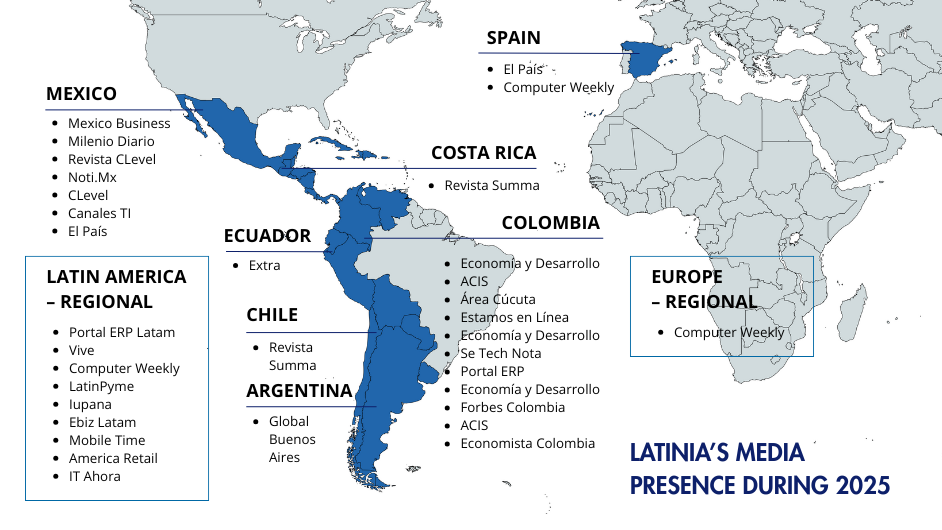
Within this discussion, outlets such as El País and Forbes, along with regional leaders like Revista Summa, Plataforma Denaria, America Retail, ComputerWeekly and ACIS Colombia, have sought expert voices and analysis to explain this shift.
Latinia’s presence in several of these media conversations reflects not recognition, but a sign of something broader: critical transactional infrastructure, real time alerts, and operational reliability have become central topics on the public banking agenda.
This article brings together those appearances and organizes the key messages we shared throughout the year. Ultimately, it offers Latinia’s view of 2025 through the media where we took part.
Smart Frictionless: a new trust logic for immediacy
One of the main threads of the year was the need to rethink the balance between speed and security in real time payments. Across eleven publications in Mexico, Colombia, Costa Rica, and Central America, Latinia took part in a discussion that went beyond the idea of a “fast transaction” to focus on how to protect operations that take place in seconds.
The discussion revolved around a concept that began to gain traction in outlets such as ACIS, Economista Colombia, Noti.mx and Revista Summa: the traditional frictionless model is no longer enough. Immediacy calls for an additional layer of judgment. This is where the idea of the smart pause comes in: a brief, data driven moment designed to reinforce the perception of security without disrupting the flow of the process.
“The future is not about removing every barrier at all costs, but applying the right pause at the right moment. We call it Kit Kat banking, the smart pause.” – Oriol Ros, Co founder of Latinia.
This pause is not designed as a slowdown, but as a discreet resource that appears only when it makes sense: to anticipate hesitation, validate unusual behavior, or prevent risk. In outlets such as Mercado y Tendencias and Portal ERP, this perspective was interpreted as a cultural shift in the relationship between banks and users: absolute speed gives way to a model where protection becomes a natural part of the experience.
Contextual relevance: communicating only when it matters
The discussion around smart frictionless led to a broader concept: the value of timing. In an ecosystem where banks, fintechs, and new digital players coexist, user attention is a limited resource, and communication shifts from a volume-driven mechanism to one based on precision.
In outlets such as Canales TI, we examined the need to intervene only when a message truly adds clarity or supports the user at a critical point in the process. It is not about increasing the number of interactions, but about using data, context, and recent behavior so that each one has a clear purpose. This is where models such as Next Best Action gain relevance as the conceptual foundation for truly contextual communication.
AI as the decision-making layer: the technical explanation the media were looking for
The natural question after discussing contextual precision was: what technology makes it possible to operate at that level of accuracy?
Both América Retail and Forbes Colombia turned to Latinia to explain how artificial intelligence is no longer a supporting tool and has become the layer that anticipates patterns, detects risk, and adapts banking communication in real time.
“The future lies in understanding not only what customers want, but also when and how they want it.” – Oriol Ros, Co-founder of Latinia.
The press did not limit itself to quoting statements. It also adopted a conceptual framework: AI does not act arbitrarily, but interprets context to respond at the exact right moment, a critical factor in a banking environment where every second can change the outcome of a transaction.
Digital payments and financial inclusion: a region in structural transition
Outlets such as El País, Computer Weekly and Denaria devoted significant space to analyzing how Latin America is moving toward more accessible, agile, and interoperable payment systems. From this perspective, Latinia took part in a discussion that goes beyond digitalization itself: financial inclusion.
In Mexico, the debate around lower fees and regulatory momentum revealed a complex reality. The country remains a cash-intensive economy, and the pace of digitalization is uneven across different segments. The most significant gap lies within the business middle class, a key driver of economic development that still faces barriers to adopting electronic payments at scale.
“Mexico handles an excessive amount of cash, and that should be a central priority in any public policy discussion. A society simply cannot remain this cash heavy.” – Oriol Ros, Co-founder of Latinia.
At the same time, systems such as Pix in Brazil, CoDi in Mexico, Dimo in Argentina, and BreB in Colombia became established as engines of inclusion. Their growth highlighted a recurring point in media discussions: infrastructure matters. Only with high availability platforms is it possible to bring millions of people and small businesses into the system who still depend on cash.
Immediacy, fraud risk, and real time trust
As real time payments became the norm across the region, media coverage naturally shifted toward an unavoidable issue: the rise of fraud. Iupana, Mobile Time, and other specialized outlets published in-depth reports quantifying the scale of the problem:
- 70% increase in fraud linked to Pix in Brazil during 2024
- 90% of cybercrime cases in Peru are associated with digital wallets
To interpret these trends, several journalists turned to Latinia as a technical source. The recurring question in interviews was always the same: how do you protect a transaction that moves as fast as the fraud attempt itself?
In this context, real time alerts took on a strategic role. Not as just another channel, but as a structural protection mechanism. The ability to intervene within milliseconds before a transaction becomes irreversible was seen as an essential tool to prevent losses and strengthen user trust.
Proactive alerts do not only respond. They anticipate. When the system detects an abnormal pattern, the notification can trigger a verification, temporarily block the operation, or prompt immediate contact with the bank. This dynamic, highlighted in Mobile Time, reinforced the idea that critical communication is now a core part of banking security.
Resilient infrastructure: a requirement for real-time operations
The rise of instant payment systems and the growing exposure to fraud revealed another critical dimension of the challenge: infrastructure. In outlets such as Extra, Latinia addressed the need for systems capable of operating reliably even during demand spikes, isolated outages, or critical service moments.
Guaranteed delivery protocols, redundant architectures, and business continuity mechanisms were framed as essential elements to sustain trust across the financial ecosystem as a whole.
Proactivity and personalization: communication as a strategic layer
Beyond security, the specialized press also sought to understand how communication between banks and users is changing in an environment where everything happens in real time. In outlets such as Mobile Time, Portal ERP and IT Ahora, Latinia was consulted to explain this shift.
The discussion revolved around an idea repeated across several articles: the banking notification stops being just a message and becomes an action.
“Proactive alerts not only protect assets, they also reinforce the perception that the institution is looking after its customers’ interests.” – Oriol Ros, Co-founder of Latinia.
An action that informs, validates, anticipates, corrects, or even influences high-value decisions such as retention or product adoption. The press highlighted that the key is not to send more alerts, but to trigger only those that respond to a specific context, anomaly, or meaningful behavior. The message stops being content and becomes a contextual intervention.
Conclusion: a system learning to operate at the user’s speed
The overall picture drawn from these 38 media appearances points to a clear convergence: Latin American banking is moving into a model where immediacy, protection, and applied intelligence must operate as a single system.
Within this interconnected ecosystem, Latinia’s presence in the public conversation reflects the value of a technical perspective that has accompanied this transition from the inside. Not as an external observer, but as part of the quiet infrastructure that supports real-time payments, decisions, and alerts.
This is precisely where the media found their interest: in understanding how banking operates when real time is no longer an aspiration and becomes a structural condition.
For Latinia, this media year does not represent visibility, but perspective: confirmation that banking across the region is advancing toward a model where interpreting context and acting at the right moment is no longer a differentiator, but a fundamental requirement for digital trust.