Last updated: October 19, 2026
Banks can combine demographic, geographic, behavioral, psychographic and predictive criteria to build useful segments. Real-time decisioning technology can then add events and contextual data to these profiles, so that actions aren’t limited to campaigns or predefined groups.
Key takeaways on customer segmentation in banking
- Banking segments draw on multiple criteria: demographics, financial behavior, needs, customer value and predictive models.
- Segmentation lets banks tailor products, services and communications to the needs of different customer groups.
- Segments must be actionable and measurable: each group should be tied to goals and outcomes the bank can track.
- Data and analytics tools help define segments, while decision engines turn that information into action.
- Banking events add real-time context, making it possible to decide when a message or recommendation is actually relevant.
- Segmentation and real-time personalization work together, but they’re not the same thing: belonging to a segment doesn’t, on its own, determine the best action at any given moment.
What is customer segmentation in banking?
Customer segmentation in banking means grouping customers by shared characteristics, needs, financial behaviors and levels of engagement. This allows banks to align their products, services, communications and customer journeys with the priorities of each group.
Beyond demographic or geographic criteria, modern banking customer segmentation can draw on transaction data, channel behavior, product holdings, customer value, predictive indicators and real-time financial events. The goal isn’t just to label customers, but to build actionable segments that lead to more relevant, measurable banking decisions.
Customer segmentation in retail banking vs. other segments
Banking is a broad and complex industry, spanning a wide range of services and customers. Each type of banking serves a specific kind of customer and therefore relies on its own banking customer segmentation strategies and methods. Here’s a quick overview of the main types of banking and how they segment:
- Retail banking: Serves individual consumers with everyday banking services such as savings accounts, checking accounts and personal loans.
- Private banking: Focuses on high-net-worth individuals, offering tailored wealth management and financial advisory services.
- Commercial banking: Serves small and medium-sized businesses with business loans, cash management and other corporate financial services.
- Wholesale banking: Works with large corporations, financial institutions and governments, offering services such as project finance and debt issuance.
- Investment banking: Serves corporate clients and high-net-worth individuals, specializing in capital markets, mergers and acquisitions, and advisory services.
While each type of banking has its own approach to segmentation, this article focuses specifically on customer segmentation in retail banking.
Retail banking: a closer look at customer segmentation
Retail banking is arguably the type of banking most people know best, since it deals directly with individual consumers and offers a wide range of products and services they use every day.
Unlike other areas of banking, retail banks typically manage large, diverse customer bases. Customers can vary widely in their financial needs, income levels, life stages, product usage, digital behavior, channel preferences and relationship with the bank.
That’s why retail banking customer segmentation helps financial institutions identify groups with shared characteristics and needs, so they can tailor products, offers, communications and customer journeys more effectively.
Retail banks can draw on multiple sources of information, including:
- Customer and account data.
- Transaction history.
- Products held and how they’re used.
- Digital and channel behavior.
- Customer value and profitability.
- Financial needs, preferences and life events.
Banks usually combine several of these data sources rather than relying on a single criterion. This is what makes segments relevant and actionable.
In the sections below, we look at the main customer profiles and customer segmentation models used in banking, and how these segments can support product design, targeted communications and real-time decision-making.
Key consumer segments and what sets them apart
Understanding the main consumer segments and what distinguishes them is essential for any bank looking to nurture and grow its customer relationships. Segmentation has become an indispensable tool for sorting customers into subgroups based on variables such as attitudes, needs and behaviors.
The profiles below illustrate some of the most relevant patterns in today’s banking market. They shouldn’t be read as a one-size-fits-all segmentation model: every bank needs to define its own segments based on its customer data, market, products and strategic goals.
Emerging customer profiles in modern banking
Based on recent findings from CRIF’s Banking on Banks 2024 report and the Accenture Banking Consumer Study 2025, today’s banking landscape can be described through several distinct customer profiles. They reflect how preferences, expectations and behaviors have shifted at a time when digital usage, trust and advice play a growing role in banking decisions.
These profiles are a useful starting point, but they only become actionable when banks translate them into measurable criteria using their own customer, transaction, behavioral and engagement data.
1. The digital-first customer
The preference for digital channels is growing steadily across all age groups.
According to CRIF, 42% of consumers in Europe and the US would only call their bank or financial provider as a last resort, reflecting the ongoing shift toward digital communication.
Profile traits:
- Uses mobile banking as their main channel for everyday transactions.
- Values real-time actions, quick decisions and frictionless processes.
- Avoids phone or in-person interactions whenever possible.
- Expects fast, clear, always-on experiences.
2. The hybrid digital/in-person customer
Digital usage keeps rising, but many customers still value human support when making major financial decisions or solving complex problems.
Accenture found that 64% of banking customers still turn to branches to resolve issues they can’t fix online, while 65% see branches as a sign of stability and availability.
Profile traits:
- Uses the app for quick transactions but may visit a branch for complex decisions.
- Prefers human interaction when resolving important issues.
- Expects continuity across channels without having to repeat information.
- Values the convenience of digital banking without giving up access to personal service.
3. The young digital customer: Gen Z and Millennials
Younger customers are especially sensitive to the quality of digital, personalized banking experiences.
CRIF reports that 17% of consumers aged 18 to 24 switched financial providers in the previous year to get better, more personalized customer service.
Accenture also found that 88% of Gen Z and Millennials are interested in building their financial knowledge, while 62% of customers overall are open to using an AI-powered financial assistant.
Profile traits:
- Expects meaningful personalization rather than generic messaging.
- Looks for financial education and guidance.
- May switch banks if the experience lacks transparency, relevance or simplicity.
- Sees banking as a mostly digital, highly accessible service.
4. The trust- and security-focused customer
Concerns about privacy, security and the use of personal data continue to shape banking relationships.
CRIF finds that 62% of customers would consider switching providers if they felt their personal data wasn’t secure.
Accenture notes that 84% of customers are concerned about how their data is used, especially as banks expand their use of AI and personalization.
Profile traits:
- Values the bank’s stability and reputation.
- Expects transparency in decisions and recommendations.
- Needs clear assurances about data use, privacy and security.
- Is more likely to engage with personalized services when their benefits and safeguards are clearly explained.
5. The advice-seeking customer
Customers increasingly expect banks to advise first and sell second, particularly when facing complex or high-stakes financial decisions.
According to CRIF, 82% of consumers believe financial providers should actively help customers avoid debt by offering products suited to their needs.
Profile traits:
- Wants ongoing guidance, not just products.
- Wants to feel the bank understands their personal and financial situation.
- Prefers personalized, transparent recommendations.
A real-world example: how Monzo uses customer segmentation
Monzo, a UK-based digital bank, uses different segmentation models to better understand customer behavior and build more relevant products and experiences.
According to Accenture’s Banking Consumer Study 2025, Monzo uses behavioral segmentation to track customer engagement and design experiments aimed at improving the user experience. It has also used attitudinal segmentation to support the development of an investment product for young and first-time investors, taking into account their attitudes toward risk and saving.
Customer feedback also plays a key role in product development, helping Monzo adapt its features as customer needs evolve.
This example shows how modern banking customer segmentation can go beyond demographic categories. Banks can combine behavioral data, customer attitudes and direct feedback to build more actionable segments and use them to improve products and customer experiences.
Earlier segmentation studies also relied on fixed consumer archetypes. For example, the BAI and Cognizant study The New Banking Consumer: 5 Core Segments and How to Reach Them identified five consumer segments in the US banking market. While these historical profiles shouldn’t be treated as a universal model today, they remain a useful example of how banks have used customer research to turn different needs and behaviors into distinct strategies.
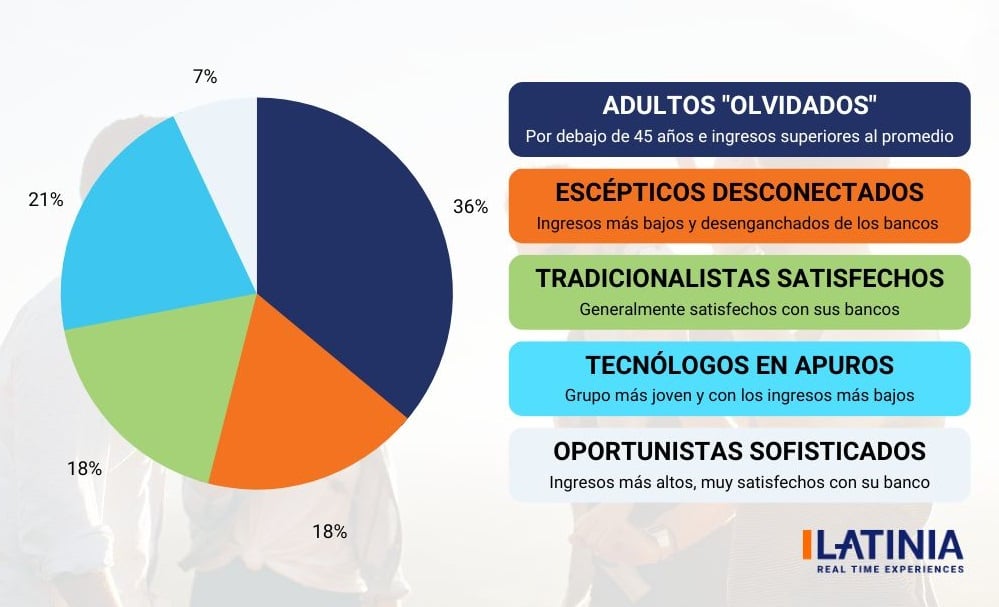
An example of historical segmentation in banking. Source: BAI Research Study (2012).
Customer segmentation models and other approaches
Banks can use different customer segmentation models depending on their goals, the data available and their ability to act on each segment. The main approaches include:
- Demographic segmentation: Groups customers by factors such as age, income, occupation or household characteristics.
- Geographic segmentation: Considers location, region, urban or rural setting and other geographic factors.
- Psychographic segmentation: Focuses on values, attitudes, interests, lifestyle and financial priorities.
- Behavioral segmentation: Looks at product usage, transaction activity, channel preferences, loyalty and likelihood to switch.
- Value-based segmentation: Groups customers by profitability, balances, products held or long-term customer value.
- Predictive segmentation: Uses data and analytical models to estimate outcomes such as propensity to buy, churn risk or future financial needs.
- Event-based segmentation: Brings in real-time events and contextual signals that may point to a specific customer need or opportunity.
A more basic approach might focus on demographics, life stages or occupations. For example:
- Young adults: Focused on building their financial lives and often new to managing credit and savings.
- Professionals and working adults: Looking for convenient, efficient banking to manage their day-to-day income and spending.
- Retirees and seniors: Often focused on wealth management, financial security and planning for a comfortable retirement.
- Entrepreneurs and business owners: Looking for scalable, flexible financial solutions to run and grow their businesses.
Each of these segments has different needs and expectations, so banks need to research and understand them in depth and adapt their services and communications accordingly.
Building and refining banking customer segmentation based on internal data, market context and strategic goals is key to keeping products, services and communications aligned with customers’ changing needs, behaviors and expectations.
Putting customer segmentation to work in banking strategy
Customer segmentation isn’t just theory. Applied well, it translates into business tactics that deliver real results.
Effective segmentation helps banks reach customers in a more personal, relevant way by aligning products, communications and services with the specific needs and behaviors of each segment.
Here’s how segmentation can drive concrete strategies across different areas of banking.
Designing personalized products and services
Understanding what different customer segments want, how they behave and what they need allows financial institutions to develop and offer products and services tailored to each group.
- Product development: Based on each segment’s characteristics, banks can create or adapt products to meet specific needs. For example, a segment of young, digitally active customers may benefit from intuitive mobile services, simplified processes and tools that make saving or investing easier.
- Value-added services: Banks can offer services such as digital financial advice for customers who prefer self-service channels, or financial education programs for young adults and first-time investors.
- Pricing models: Banks can set pricing and fee structures that match each segment’s expectations and means, such as fee-free accounts for younger customers or premium services for higher-value segments.
Targeted marketing strategies
When it’s precise and relevant, marketing can significantly boost customer acquisition and retention.
- Personalized communication: Segmentation data can help craft messages that speak directly to customers’ needs and interests, such as emails, push notifications or in-app messages highlighting genuinely relevant products or offers.
- Offers and promotions: Banks can design promotions aimed squarely at target segments. These might include offers for new customers, products tailored to specific life stages or services tied to a customer’s financial behavior.
- Targeted advertising: Online ad platforms can show ads to defined customer groups, helping banks improve relevance and maximize return on ad spend.
A banking customer segmentation strategy should link each segment to a clear goal, a relevant offer or action, the right channel and a measurable outcome. Segmentation alone, however, doesn’t tell you whether it’s the right moment to reach out. Transaction behavior, financial events and real-time context can make targeted offers far more relevant.
Improving the customer experience
A positive customer experience is crucial for loyalty and, ultimately, for the success of any banking business.
- Customer journey: Banks can analyze how different segments interact with their services and optimize each journey to make it as intuitive and seamless as possible.
- Customer support: Support and communication channels can be tailored to each segment. Some customers may prefer virtual assistance, while others value a more personal, direct approach.
- Platforms and channels: Digital platforms can be adapted to the expectations of different segments, making sure the most relevant features and information are easy for each group to find.
“In today’s banking landscape, if you’re talking to everyone, you’re talking to no one. Real relevance doesn’t come from having lots of products, but from offering the right product to the right person at the right time.”
What tools and software do banks use to segment customers?
Banking customer segmentation requires tools that can integrate data, spot patterns and turn information into groups that are useful for the business. The key technologies involved are:
- Banking CRM: centralizes information about customers, their products and their interactions with the bank.
- Customer Data Platforms (CDPs) and data platforms: bring together information from different sources to build unified profiles.
- Analytics tools and predictive models: identify behaviors, needs, risks and opportunities to define more precise segments.
- Marketing and automation platforms: use those segments to select audiences and run campaigns.
- Real-time decision engines: complement segmentation with events, context and business rules to determine which action makes sense at any given moment.
These technologies may share some features, but they don’t necessarily do the same job. Segmenting customers identifies groups; real-time decisioning determines how to act in a specific situation.
Where does Latinia fit in?
Latinia is a software platform for real-time banking communications that connects the bank’s transactional systems with its communication channels. It analyzes events and contextual data, applies business rules and helps decide what to communicate, to whom and when, while handling notification delivery securely, efficiently and with full traceability.
Its engines provide different capabilities related to customer insight and communication activation:
- RTD Subscription: manages customers’ alert preferences, such as transaction types, amount thresholds and preferred channels. This information can enrich customer profiles and support segmentation based on stated preferences.
- RTD Universal: analyzes banking events and applies business rules to determine which communications should be triggered in each situation.
- RTD NBA/O (Next Best Action / Next Best Offer): uses customer context and activity to identify the right moments to trigger relevant actions, recommendations or offers.
In this way, Latinia complements the bank’s segmentation tools, making it possible to use customer information and transactional events to deliver more timely, personalized communications.
A practical framework: how to implement customer segmentation in 4 steps
Segmentation really proves its worth when you move from theory to execution. While plenty of industry reports describe what segmentation is, few explain how banks can actually put it into practice. The four-step framework below offers a clear, actionable way to implement segmentation within a financial institution.
Step 1: Data collection and analysis
Effective segmentation starts with quality data. Banks need to collect and unify information from transaction activity, digital behavior, product usage and customer interactions across channels.
This stage also calls for responsible data practices, including clear governance policies, proper consent management and compliance with privacy regulations such as the GDPR. The goal is to build a reliable data foundation that delivers accurate insight into customers’ needs, preferences and intentions.
Step 2: Defining segments and buyer personas
Once the data is organized, the next step is to identify meaningful groups. Banks can classify customers by demographic attributes, behaviors, financial goals, life stages or levels of digital engagement.
From these groups, institutions can build detailed buyer personas that capture each segment’s motivations, challenges and expectations. Well-defined buyer personas help teams design relevant products, messages and service models.
Step 3: Activating communication with the right action
Communication only has an impact when it leads to a relevant action. That requires technology capable of delivering the right product, message or notification at the moment it’s most useful to the customer.
Real-time decision engines play a decisive role here. The RTD NBA/O Engine analyzes customer events and transactions as they happen and determines the most relevant next action for each person.
For example, a large deposit can trigger an assessment of the customer’s profile, eligibility, past interactions and current context. The decision engine can then determine whether a savings or investment recommendation makes sense and choose the most suitable available channel.
This means communication isn’t limited to static campaigns: it can respond to the customer’s context through more timely, relevant interactions.
Step 4: Measuring success with KPIs
No segmentation strategy is complete without proper measurement. Banks should track each segment’s performance through key indicators such as Customer Lifetime Value, churn rate, product adoption, conversion and engagement with personalized communications.
Tracking these KPIs lets financial institutions refine their segmentation models, identify friction points and fine-tune their products, offers and communication strategies to increase business impact.

Expert tip: the real value lies in the moment
Segmentation helps banks understand who the customer is, but the real opportunity comes when the bank detects an event that reveals what the customer is going through right now.
The most relevant action doesn’t depend solely on how the customer is classified. It also depends on whether the bank can recognize the right moment and respond with an action that’s useful, contextual and appropriate.
From customer segmentation to event-based activation
Customer segmentation remains a valuable tool for understanding profiles and behavior patterns. It helps identify groups, anticipate interests and plan strategy with a broad view. However, segmentation usually ends up in scheduled campaigns sent at times set by the bank: a date, a time or a predefined flow.
That means communication depends more on the moment the bank has designed than on what the customer is actually experiencing at that moment. Segmentation describes who the customer is, but not necessarily what they’re doing right now or whether it’s the right time to act.
An approach built around events and context
Most customers spend only a few minutes a day using digital banking. With so little time, it’s hard to reach them through scheduled campaigns or segmentation that depends on their browsing. Which raises an unavoidable question: how can a bank act when the customer is barely there?
This is where context comes in.
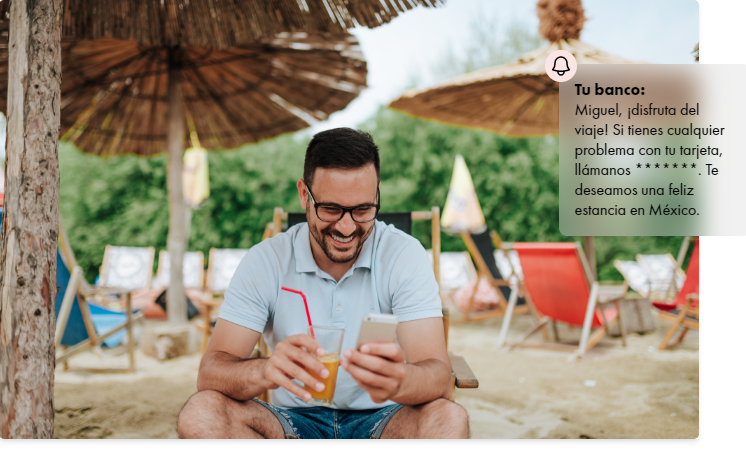
Every interaction, such as a failed payment, an unusual login or a one-off withdrawal, happens at a specific moment and generates information that helps the bank understand what the customer is going through.
To respond appropriately, the bank needs technology that can detect these events in real time and decide whether it makes sense to act. Latinia’s RTD Universal Engine does exactly that: instead of trying to predict behavior solely through static flows, the bank can respond based on what the customer is experiencing in the moment.
Contextual activation with Next Best Actions
Next Best Actions pinpoint the moment something relevant happens in a customer’s life and determine the most appropriate action for that moment.
Latinia’s RTD NBA/O Engine analyzes events and their associated data to select the most useful content and deliver it through the most suitable available channel.
Each NBA rule can be configured with no additional development and includes a saturation control that keeps customers from receiving more messages than they need. This helps maintain trust and ensures a carefully managed experience.
Further reading: how to implement Next Best Actions successfully
To help banking teams put NBAs into practice, Latinia offers a free guide on creating, running and optimizing NBA strategies.
In this guide, you’ll learn how to:
- Strengthen customer relationships with NBA-driven strategies.
- Define relevant NBAs and identify the right moments using transactional and location-based events.
- Apply best practices to avoid intrusive communications and use the right channels securely.
- Improve conversion and increase sales of banking products.
- Use Latinia’s NBA capabilities to roll out an NBA strategy easily, with full real-time capabilities.
Download the NBA implementation ebook
Measuring ROI: the KPIs that matter in banking
To assess whether a segmentation strategy is really driving business impact, banks need to monitor the right performance indicators. These KPIs show how effectively each segment contributes to growth, profitability and long-term customer value.
Customer Lifetime Value (CLV)
CLV helps determine the long-term revenue potential of each segment. Knowing which groups generate the most value over time lets banks prioritize investment, personalize offers more efficiently and allocate resources where they’ll have the greatest impact.
Customer churn rate
Churn shows how many customers are leaving the bank and how segmentation can help keep them. Identifying which segments show early warning signs lets teams act in time to strengthen loyalty and reduce lost revenue.
Product penetration rate
This KPI measures how many products customers in each segment use. Higher penetration reflects stronger relationships, better cross-selling and greater engagement. Tracking it helps uncover opportunities to drive adoption and design more relevant product bundles.
Final thoughts on customer segmentation in banking
Customer segmentation in banking is more than a marketing strategy: it’s essential to delivering financial products and services effectively and efficiently. Correctly identifying and analyzing different customer groups allows banks to personalize their offering, streamline operations and maximize profitability.
As an industry that touches virtually every other part of the economy, banking benefits greatly from understanding and anticipating customer needs through effective segmentation.
Future strategies and the evolution of customer segmentation
Looking ahead, banks will face new challenges and opportunities in customer segmentation. The rapid adoption of digital technologies, shifting customer preferences and an evolving regulatory landscape will all shape segmentation strategies.
Artificial intelligence, machine learning and predictive analytics will become increasingly common and sophisticated, enabling deeper, more dynamic segmentation and personalization. Customer expectations for personalized, frictionless banking experiences will also keep rising, pushing banks to continually innovate in their segmentation strategies and in how they deliver products and services.
Segments will increasingly evolve from fixed groups into more dynamic models that reflect changes in customer behavior, financial needs and real-time context.
Considerations and next steps for banking professionals
For banking professionals looking to make the most of customer segmentation, the following steps and considerations can be crucial:
- Technology adoption: Embrace and make full use of emerging technologies, such as real-time analytics and decision engines, to improve the accuracy and effectiveness of customer segmentation.
- Customer focus: Make sure segmentation strategies and the resulting offers are genuinely aligned with what customers need and want. Learn more about customer-centric banking.
- Strategic agility: Build the ability to adapt segmentation strategies quickly to changes in the market and in customer behavior.
- Regulatory compliance: Ensure segmentation strategies and how they’re implemented comply with applicable local and international regulations. Learn more about security and regulatory compliance in banking.
- Continuous innovation: Foster a culture of ongoing innovation to anticipate emerging customer needs and stay competitive.
- Ongoing training: Make sure teams have the skills and knowledge to interpret segmentation data effectively and act on it.
Rather than trying to overhaul their entire segmentation strategy at once, banks should start with a clearly defined, measurable use case. This makes it easier to validate results, refine the model and gradually scale what works.
Conclusion
Ultimately, customer segmentation in banking will remain a core strategic pillar, giving institutions the tools and insight they need to serve their customers well and navigate an ever-changing financial landscape.
Banks that combine effective segmentation strategies with advanced technology and customer-centric execution will be best placed to tailor their products, communications and decisions to each customer’s needs and context.
To find out how Latinia can help your bank turn customer segments and real-time financial events into relevant, measurable actions, get in touch with our team.
Frequently asked questions about customer segmentation in banking
What are the most common types of customer segmentation in banking?
The most common models are demographic, geographic, psychographic and behavioral segmentation. Banks also use criteria based on customer value, predictive models and signals from financial events. The right choice depends on business goals, available data and customer needs.
Why is it important to segment banking customers?
Segmentation helps financial institutions understand the needs of different customer groups and tailor their products, services and communications accordingly. It also makes it easier to identify commercial opportunities, improve the customer experience and measure the results of each strategy with segment-specific KPIs.
What tools do banks use to segment their customers?
Banks use CRM tools, customer data platforms (CDPs), analytics solutions and predictive models to build and manage segments. These technologies can be complemented by real-time decision engines, which combine available customer information with events and business rules to determine relevant actions.
What’s the difference between banking segmentation and real-time personalization?
Segmentation groups customers by shared characteristics or behaviors. Real-time personalization adds the context of a specific situation, such as a transaction or financial event, to decide whether to act, what to communicate and when. The two work hand in hand, but they serve different purposes.