Updated 07/10/2026
Real-time personalization in banking is the ability to reach each customer at the most opportune moment, triggered by an event such as a card purchase or a salary deposit rather than a campaign calendar. The bank cross-references that event with what it knows about the customer and with its business rules to decide whether to communicate and what to say, or whether it’s better not to communicate at all.
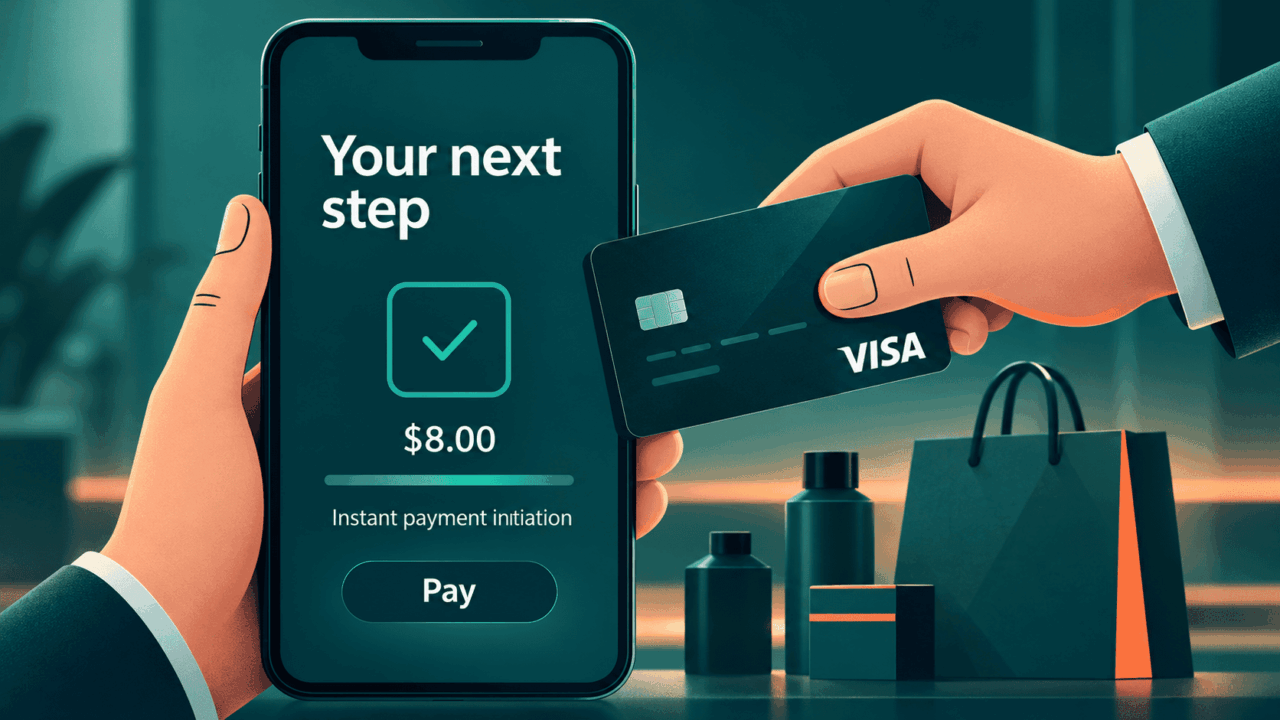
A banking communication is worth more the closer it arrives to the moment that prompts it. A card purchase alert is useful in the seconds after payment, while the customer is still in the store. Real-time personalization starts from that idea: every customer transaction becomes an opportunity to communicate at the moment that suits them best, instead of following a campaign calendar.
Key takeaways
- Real-time personalization turns every customer transaction into an opportunity to communicate at the most opportune moment.
- Unlike a traditional campaign, communication is triggered by a customer event, not a calendar.
- The decision always follows the same sequence: event, customer context, business rules, decision and action.
- A decision engine determines the most opportune moment to communicate any information.
- Personalization also means deciding when not to communicate.
What is real-time personalization in banking
Real-time personalization goes beyond inserting the customer’s name into a message or choosing the right segment. It means turning a specific occurrence, such as a banking transaction, into a communication opportunity the instant it happens.
That occurrence is what we call an event: any transaction the bank records at the moment it takes place. It can be a card transaction, a transfer, a salary deposit, a cash withdrawal or a change in balance.
Three models help put the leap into perspective:
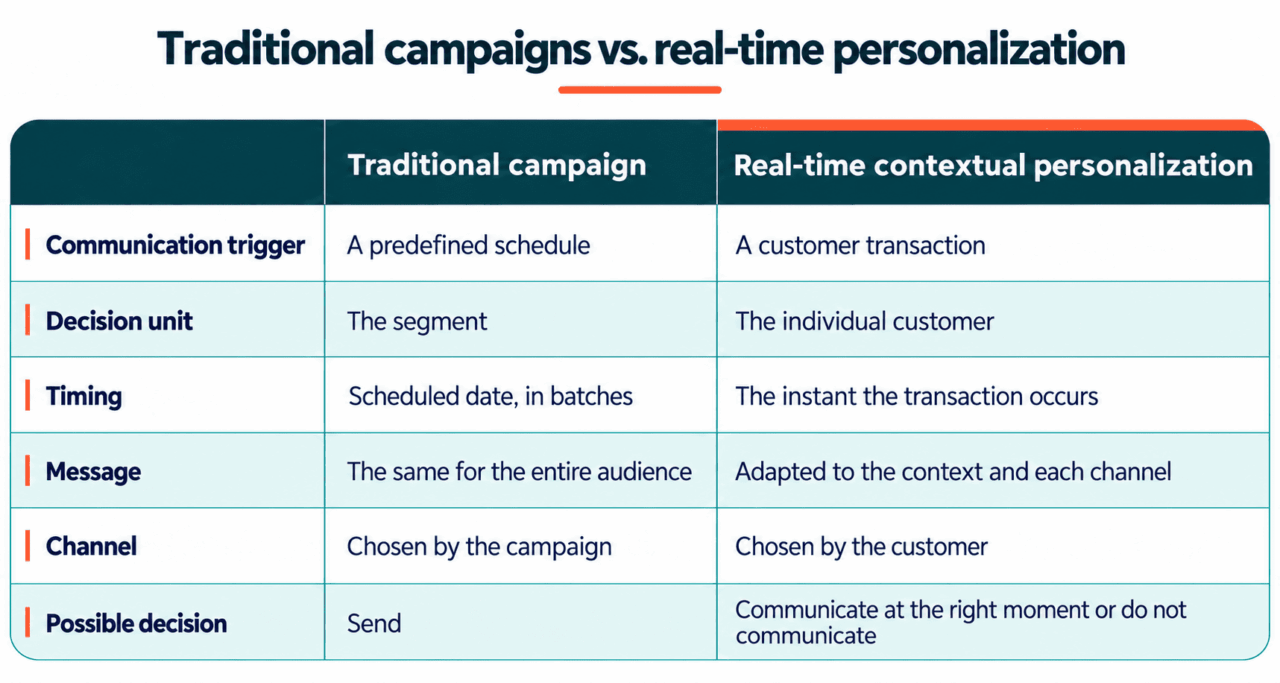
- Traditional campaign. This is the logic of classic marketing automation. The bank defines an audience, a message and a schedule in advance, and sends the same communication to the entire segment by email, SMS or push notification.
- Conventional personalization. It tailors content to the customer’s profile and historical data. This is the logic behind customer segmentation in banking.
- Real-time personalization. A customer transaction triggers the decision, and the communication adapts to what the customer is experiencing at that moment.
This last model is the most demanding form of hyper-personalization in banking, because it adds time as a variable.
From traditional campaigns to real-time contextual personalization
Mass email, direct mail and promotional SMS have been the backbone of banking communication for decades. They reach a broad audience with uniform messages, but they rest on one assumption: that every customer in a segment behaves the same way. Communication arrives on the bank’s schedule, even when the customer’s moment is a different one.
How it works: from transaction to decision
A real-time decision engine applies this logic to any communication, whether it’s an alert, an informational notice or an offer. Every decision follows the same sequence:
- An event occurs, for example a card purchase.
- The engine cross-references it with what the bank knows about the customer.
- It evaluates the business rules defined by the bank.
- It decides whether to communicate, what to say and through which channel.
- It triggers the action and measures the result.
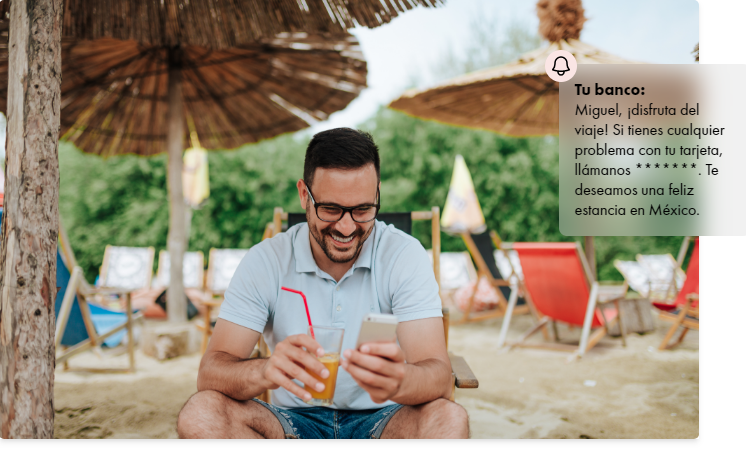
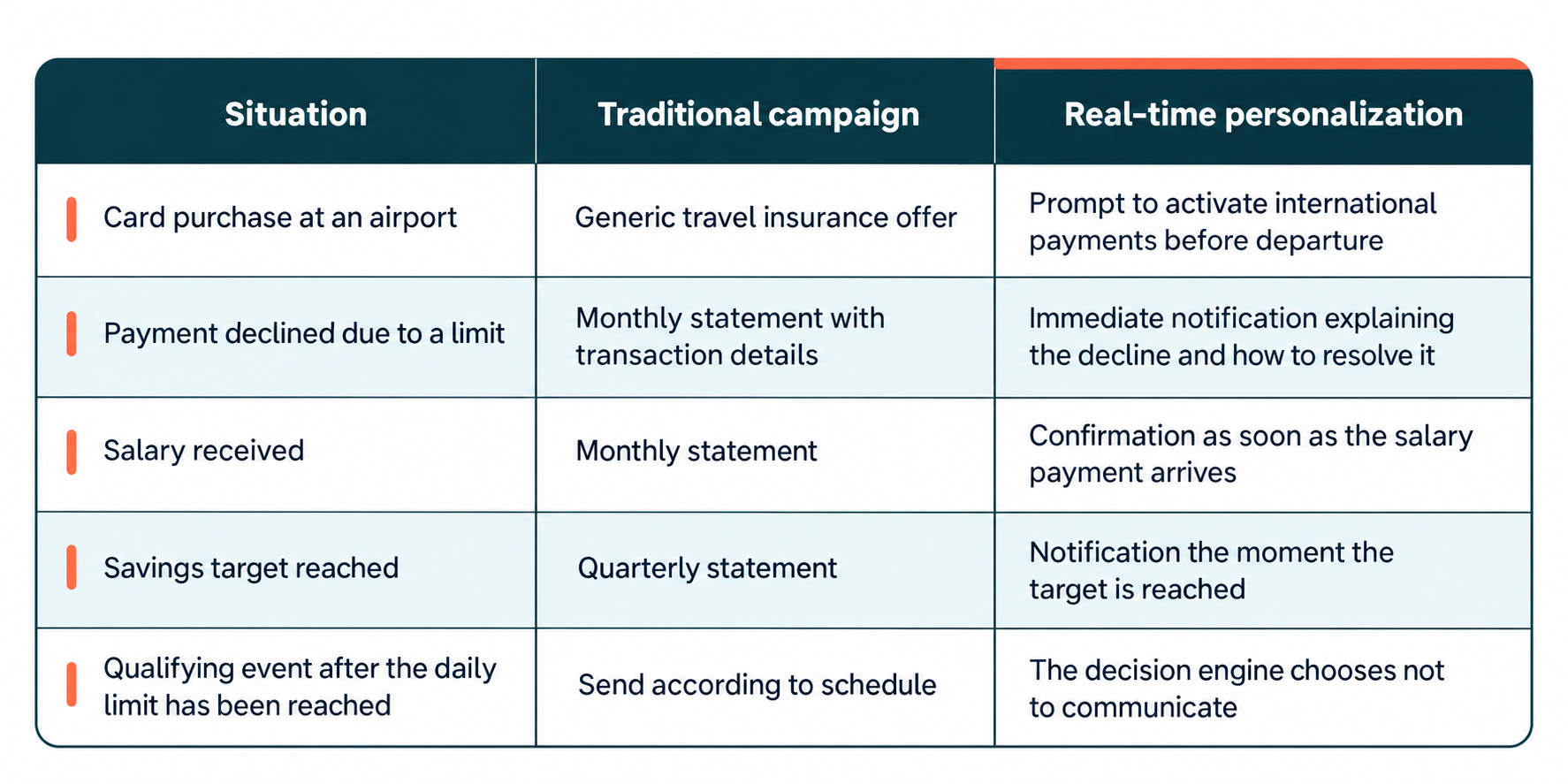
The same event can lead to different decisions depending on the context. For example, a customer pays by card at an airport:
- If the bank knows they’re starting a trip abroad and don’t have international payments enabled, the decision is to show them a useful notice to enable them.
- If the customer travels regularly and already has everything enabled, the decision is to send nothing.
Because every decision is rule-based, the bank can explain why it communicated something and also why it didn’t.
What signals enable real-time personalization
A real-time decision combines three types of information:
- The customer’s transactions, drawn from real-time transactional data: payments, transfers, deposits, cash withdrawals or limit-related declines.
- What the bank already knows about the customer: the products they hold (accounts, cards, loans), their usual behavior and their history.
- The communication preferences the customer has chosen.
The decision comes from cross-referencing all three. Together, the transaction, the customer’s context and the business rules indicate whether a communication adds value at that moment.
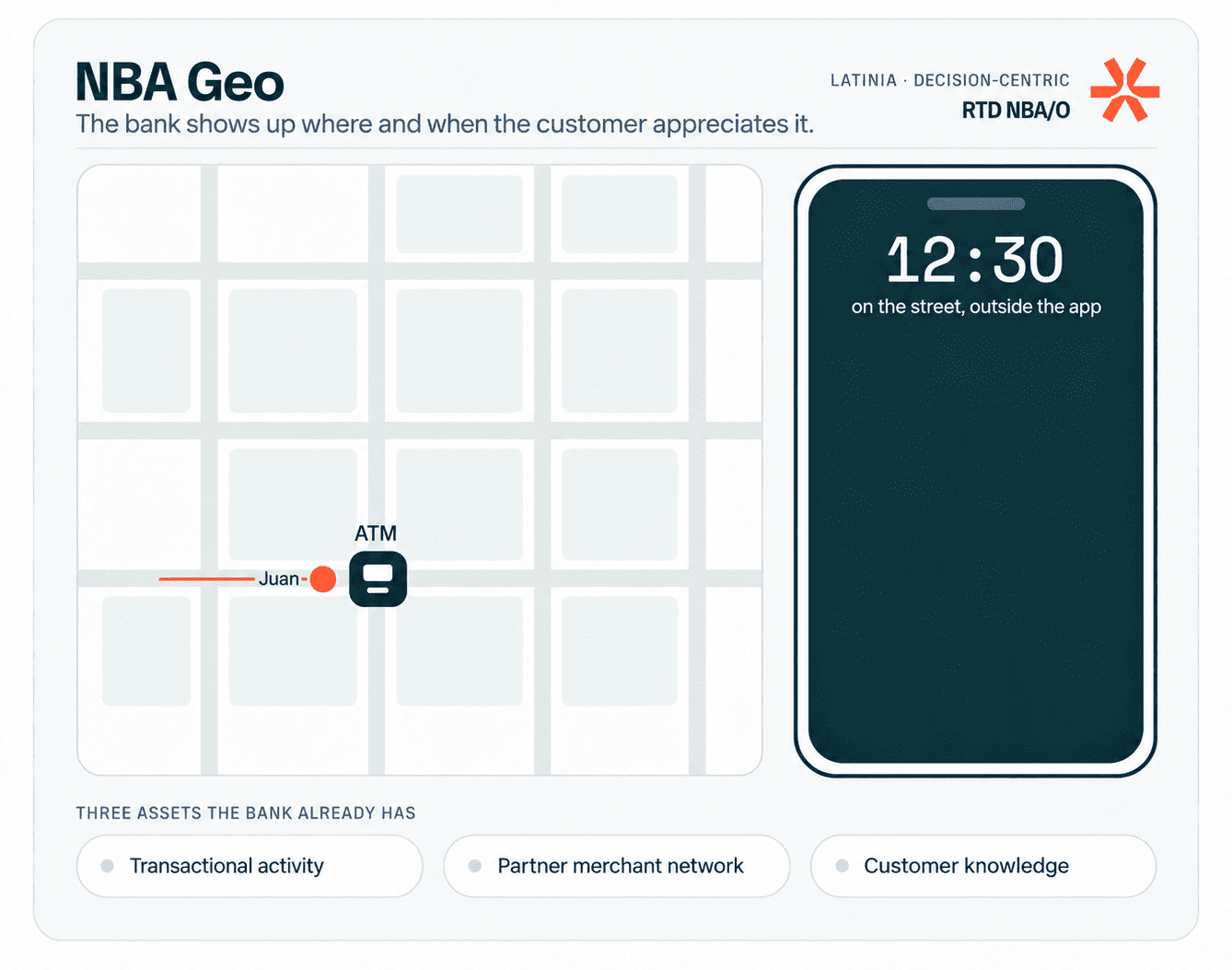
Geolocation: when location changes relevance
Geolocation adds the “where.” Linked to a transaction and with the customer’s consent, it helps interpret a situation more accurately, such as a purchase at an airport or a payment in a new city. It enriches the decision when it adds value, although it isn’t a requirement for every form of personalization.
From moment to message
Once the bank knows when to communicate, it still needs to decide how and where. The goal is for every notification to add value beyond informing: speaking to the customer in the right tone, at the right moment and in the right context.
To achieve this, the message adapts to four variables:
- The most suitable channel at each moment. If the customer has the bank’s app, a push notification. If they’re abroad, an SMS.
- The format of each channel. A push notification can include images, icons and clear calls to action, tailored to each customer.
- Each customer’s data, inserted through hyper-personalized tokens to add context, such as the last digits of the card or the transaction amount.
- The regulations that apply to each communication.
One example is a welcome push notification with an image, different typefaces for the title and the body text, and a warm tone aligned with the bank’s identity. Its sole purpose is to welcome the customer and speak to them on a personal level. This is the first layer of personalization: the visual experience, which aims to build an emotional connection with the customer.
All of this with a consistent tone and style across every channel, thanks to templates that are written once and adapt to each channel and each customer.
Personalization also means knowing when not to communicate
Greater personalization capability can translate into more messages. To ensure every communication keeps its value, the bank governs the decision with four criteria:
- Priority: critical alerts, such as a fraud warning, take precedence over any commercial message.
- Frequency caps: set per action, per transaction type and per customer.
- Preferences: each customer uses a preference center to choose which alerts they receive, from what amount and through which channel.
- Silence: the engine can decide not to send anything and explain why.
Real-time contextual personalization examples
Each example compares the traditional campaign with a communication decided at the most opportune moment for the customer.
EXPERT TIP
Start with the transactions that raise the most questions for your customers, such as a declined payment or an incoming deposit. For each one, define the moment and the channel in which the information is useful to them. These are the cases where real time adds value from day one.
What a bank needs for real-time personalization
A bank needs seven capabilities:
- access to real-time events;
- customer context data;
- business rules;
- a decision engine;
- channel activation;
- frequency and preference governance;
- results measurement.
With these pieces in place, communication starts responding to each customer’s moment.
How Latinia does it
Latinia’s Universal RTD Engine applies this logic to any communication. It interprets each event, cross-references it with the customer’s context and the bank’s rules, and decides the most opportune moment to communicate, whether it’s an alert, an informational notice or an offer. It also includes saturation control per action, per transaction type and per customer.
The Template Manager, built into the Critical Alerts Gateway, lets teams write each message once and deliver it across every channel (email, SMS, push, WhatsApp and RCS) with centralized control. It translates the content, adapts it to each channel and to current regulations, and integrates each customer’s dynamic data. It also provides fallback templates in case of delivery failures and an AI agent that works in natural language, currently in beta.
Latinia has spent more than 25 years helping banks communicate at the most opportune moment for each customer. If you’d like to see how to bring this to your organization, talk to our team.
FAQs
What is real-time personalization in banking?
It’s a bank’s ability to tailor a communication to what’s happening to a customer the instant it happens. A transaction, such as a card purchase or a deposit, is cross-referenced with what the bank knows about the customer and with its business rules. From there, the bank decides whether to communicate, what to say and through which channel.
How does real-time personalization differ from a traditional banking campaign?
A traditional campaign defines an audience, a message and a schedule in advance. With real-time personalization, a customer transaction triggers the decision the moment it occurs. Communication then adapts to each customer’s moment.
What data can a bank use to personalize a communication in real time?
Three types of data: the customer’s transactions as they happen, such as payments, transfers or deposits; what the bank already knows about them, such as the products they hold and their usual behavior; and the communication preferences the customer has chosen. Geolocation can be added, always with consent.
How can a bank avoid overwhelming customers with personalized communications?
With four criteria: priority for critical alerts over commercial messages; frequency caps per action, transaction type and customer; preferences chosen by the customers themselves; and the option to send nothing at all. Because the decision is rule-based, the bank can always explain why.