According to Reuters, 43% of users turn off alerts because they find them excessive or irrelevant. The rapid pace of digitalization has made push notifications a cornerstone of communication between…
Read More
 Latinia

According to McKinsey, nearly 73% of interactions between banks and customers already take place through digital channels.
In today’s banking landscape, notifications are no longer simple operational responses: they represent a direct extension of the bank’s brand promise. Security, compliance, and customer experience converge in a single point: channel governance.
Every notification, alert, or notice that appears on a user’s mobile device has become a tangible piece of trust in motion.
But who governs that communication? How does a financial institution ensure that each notification — from a fraud alert to a payment notice — is secure, verifiable, and compliant with the rules that govern its digital operations?
In the modern architecture of banking notifications, management is no longer limited to delivery: it requires an internal governance layer that decides, controls, and supervises the complete cycle of each alert — from generation to delivery and recordkeeping. Latinia operates as that internal governance layer that acts before, during, and after final delivery to channel providers.
This model — based on pre-control, supervised delivery, and post-audit — aligns with regulatory frameworks that require financial institutions to strengthen digital resilience, traceability, and operational security.
The push channel has become an essential component within the banking notification ecosystem. Its immediacy and zero cost make it ideal for communicating real-time transactional events. However, in its most basic form, it remains an ephemeral channel, with no persistence or verifiable traceability. In banking, where every event may have regulatory or trust implications, this limitation makes it insufficient on its own.
For this reason, at Latinia, we have evolved push into a banking channel with its own identity — governed, auditable, and secure — transforming it into a critical channel capable of offering persistence, legal evidence, and full control over every notification. Thus, the alert ceases to be ephemeral and becomes a traceable and reliable interaction, fully integrated into the bank’s digital architecture.
Throughout the seven pillars that follow, we explain how to leverage all the potential of this channel — not only to overcome its limitations but to turn those limitations into a competitive advantage for the bank.
The banking push channel managed by Latinia incorporates all the specialization capabilities of the sector and becomes a channel truly designed for banking.
Some banks are already moving in this direction.
OCBC Bank (Singapore), for example, announced that it would stop using SMS as the default channel for banking transaction notifications, migrating to push notifications managed entirely within its mobile app. By doing so, the institution not only gains immediacy but also greater internal control over communication, reducing dependence on third parties and strengthening governance and channel security.
In other markets, Axis Bank (India) implemented contextual real-time push notifications, integrated with WhatsApp and email through artificial intelligence. Although the bank does not use the term “governance layer,” its multichannel strategy reflects advanced orchestration of the push channel, based on control, context, and intelligent decisioning.
These examples illustrate a global trend: banking communication is no longer a one-way flow but a governed, auditable, and resilient architecture, where every critical notification is processed individually, with low latency, full traceability, and end-to-end security.
A layer that not only enhances operational efficiency but also raises the standard of digital trust and strengthens the relationship between the bank and its customers.
After more than two decades of specialization collaborating with financial institutions in Europe and Latin America, we have compiled a synthesis of the seven essential pillars that elevate the push channel into a key component of modern banking communication, thanks to the management and governance layer provided by Latinia.
In any banking notification architecture, economic efficiency depends on the balance between high-cost channels and the bank’s own digital channels.
Among the most cost-effective is the push channel, which combines immediate visibility, internal control, and zero operating cost, making it the most efficient medium within the bank’s digital ecosystem. It is the only digital channel with zero cost.
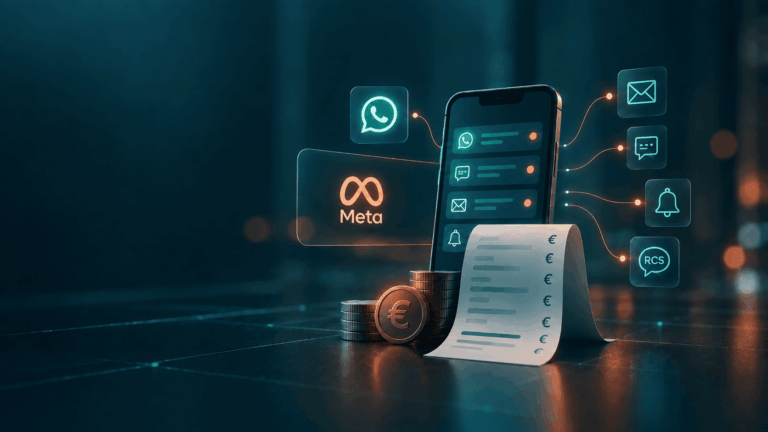
In this context, SMS remains a universal and reliable channel, but its per-message cost multiplies when it comes to large-scale operations. Other channels such as email, WhatsApp, or RCS offer different advantages in reach or format, but also involve variable costs or third-party dependence.
On average, a financial institution sending 40 million notifications per month can save over USD 6 million per year by replacing SMS (USD 0.025 per message) with push notifications.
In our experience, institutions operating under our push governance framework have achieved significant reductions in operating costs, without compromising security, traceability, or regulatory compliance.
As digitalization progresses, this saving grows because more customers become digital: every customer who migrates to push reduces the use of external channels and strengthens a more sustainable model. Thus, push becomes a direct driver of financial efficiency, and for that reason, at Latinia, we consider it essential for any financial institution to adopt push as the priority channel for all types of notifications.
Before adopting a new channel, every bank asks the same questions:
These questions are critical: adoption usually determines the real viability of any digital communication project.
Latinia designed its push solution precisely to ensure immediate, zero-impact adoption in the bank’s notification ecosystem. Our solution allows existing notification flows to be redirected toward the push channel without rewriting code or altering existing integrations. The result is an instant migration, with no impact on the sender systems or the customer experience. In other words, we move from the complexity of a technological project to the simplicity of adopting a Latinia feature.
If a bank is already sending its SMS notifications through Latinia, once it prioritizes the push channel, it can leverage a logic that detects a notification and automatically routes it via push. Because the same notification flows are reused, traffic is redirected toward a new channel without modifying the core banking components that generate them.
In this way, Latinia provides banks with a strategic capability, reducing time-to-market and accelerating digital channel adoption.
Security is the neural center of any banking communication.
By nature, push notifications travel through third-party infrastructures — Apple, Google, or Huawei — which introduces an unavoidable dependency in terms of confidentiality and traceability.
Publications such as Wired (“The Privacy Danger Lurking in Push Notifications”) and Tom’s Guide (“Apple and Google confirm governments could be spying on your push notifications”) have warned about this reality: operating systems may be required to share notification metadata with governments or third parties, revealing information about usage habits, locations, or behavioral patterns. Although these practices occur in specific contexts, they expose a structural vulnerability: the bank does not have total sovereignty over the notification.
In a regulated financial environment — where each alert may have legal, operational, or reputational implications — delegating notification custody to external providers compromises channel sovereignty.
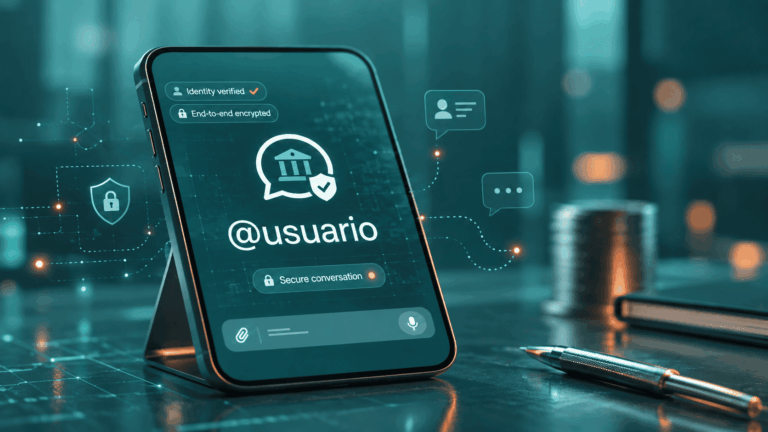
That’s why Latinia returns full control to the bank through the bank inbox, a secure space within its own app where notifications persist under the same protection, encryption, and audit policies as the institution’s core systems.
This approach ensures complete sovereignty, traceability, and end-to-end confidentiality, eliminating fraud vectors and exposure to external networks. More than a technical reinforcement, it represents a new understanding of trust: banking notifications are only secure when they are under the bank’s own control.
In digital banking, what cannot be traced cannot be trusted.
Traceability is not just a technical log: it’s the operational memory of the channel — the evidence that each alert was generated, processed, and delivered under the bank’s own rules.
In the Latinia push channel, traceability means being able to record, interpret, and certify the entire lifecycle of a notification, from its origin to the customer’s final interaction. Thanks to the custody model within the Inbox, the bank maintains a complete and verifiable view of every event, with total behavioral control.
Unlike native push services — Firebase, APNs, or Huawei — which merely confirm delivery, Latinia provides full observability and auditable logs, meeting the most demanding standards of the financial sector. Thus, traceability stops being a technical metric and becomes a pillar of regulatory compliance, internal control, and digital trust.
At Latinia, we developed the External Historical Exporter, a component designed to extract, store, and securely share all channel records, integrating them directly into the bank’s compliance and audit systems.
Because in modern banking, trust is not promised — it’s proven.
Security and traceability lose meaning if a critical notification never arrives.
At Latinia, the Inbox is not only a space of custody and sovereignty but also a center of operational continuity: it allows the bank to track the status of every notification, detect failures, manage retries, and activate alternative routes when a channel or provider fails.
This capability materializes in Channel Derivation, one of the features that enables Operational Resilience in the bank’s communication system, ensuring delivery even in failure scenarios. If a push notification is not confirmed, the system can automatically reroute the event to another active channel — SMS, email, or WhatsApp — preserving immediacy and traceability.
According to the Basel Committee on Banking Supervision (as reported by Reuters, July 2024), banks must “maintain the capacity to deliver critical operations even during disruption, especially when involving third-party providers.”
In an environment where banks rely on multiple channel providers, the intelligence layer prevents the loss of operational control. Latinia acts as a resilient governance layer, overseeing end-to-end delivery and maintaining message consistency, regardless of who performs the last mile.
What good is a notification if you can’t act on it? In banking, where seconds can mean the difference between a secure transaction and a fraud attempt, interaction changes everything.
The push channel enables something that other channels often cannot: moving from alert to immediate action. With Latinia, this interaction happens within the bank’s secure environment. The customer can block a card, authorize a payment, or validate a transaction with a single tap.
The notification ceases to be a simple message and becomes a mini banking interface, designed to resolve what once required additional steps — or even a call to customer service.
And when the interaction requires more than a quick response — as in a fraud attempt — our Push Journey functionality comes into play: guided flows that accompany the customer step by step, with full traceability. What’s most interesting is that these journeys can be created and managed without technical teams, giving business areas full autonomy to manage their own communications, reducing time-to-market and improving internal user experience.
And it’s precisely in this ability to act that the next frontier of the push channel begins: personalizing every interaction. Because not all alerts require the same response, nor do all customers react the same way. Interaction is the starting point for smarter, more relevant experiences.
In the evolution of the push channel, the final frontier is not technological but emotional. After ensuring security, traceability, and action, comes the moment to give meaning to every message. In the relationship between a bank and its customer, the difference is not frequency — it’s relevance.
Hyper-personalization turns the notification into an extension of the customer experience.
It’s no longer about sending a message, but about speaking in the right tone, at the right time, and in the right context. Every push can convey security — an alert arriving exactly when something seems suspicious — convenience — a one-tap way to resolve a payment — or closeness — a message celebrating an achievement or special date.
At Latinia, hyper-personalization does not depend on external integrations or ad hoc developments. It’s based on dynamic templates configurable directly by business teams, allowing them to modify content, structure, or design without technical intervention.
These templates can include event or customer variables, conditional functions, and formatting rules that automatically adapt the message according to context — for example, transaction type, time of day, or user’s preferred channel. This allows the bank to maintain visual consistency and information accuracy across all communications.
Furthermore, the model distinguishes between public and private content, adapting sensitive information to the user’s authentication level or security perimeter. The result is a channel that preserves technical efficiency without losing adaptability.
Ultimately, hyper-personalization ceases to be an abstract concept and becomes an operational mechanism of control and efficiency, allowing the bank to adjust communication in real time with technological independence and full message governance.
The result is a channel that does not interrupt but accompanies; that does not speak to everyone, but to each individual. Because in digital banking, relevance is the new closeness, and every notification that arrives at the right moment strengthens something deeper than information: it strengthens trust.
Explaining the seven pillars of the push channel is not a theoretical exercise. It arises from a real need: to illustrate the strategic value of a channel that has evolved from operational to structural within banking communication.
Every notification — from a fraud alert to a payment confirmation — today demands control, traceability, and coherence. It’s not enough to send it: it must be governed.
A channel that, with Latinia:
The value of push does not lie in the message itself but in everything that sustains it: the intelligence that decides, the architecture that protects, and the evidence that certifies.
The channel ceases to be a delivery medium and becomes a trust infrastructure — living, auditable, and resilient.
Because in banking communication, to govern is to protect. And that has been our purpose: to give banks full control over what matters most — their customers’ trust.








Contact