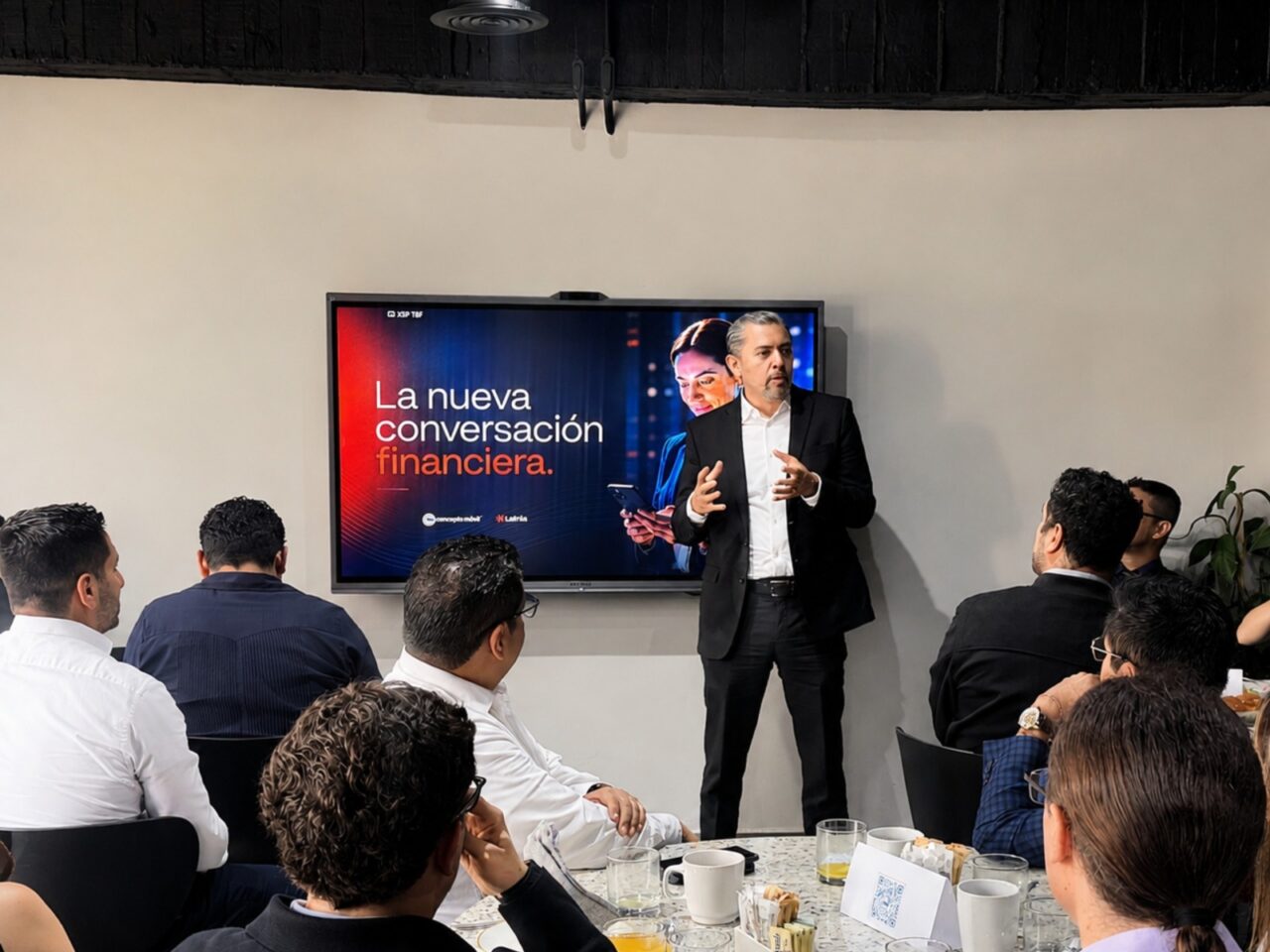
Concepto Móvil and Latinia brought together financial industry leaders on June 3 in Mexico City to analyze how artificial intelligence, conversational banking, and real-time decision-making are redefining the relationship between banks and customers.
For years, much of the conversation around digital transformation in banking focused on channels.
New channels. More channels. Better channels.
However, the market seems to be progressively shifting its focus toward a different question:
What happens before the conversation?
This was one of the main reflections recently discussed in Mexico City, where representatives from financial institutions joined Concepto Móvil and Latinia to analyze the role of artificial intelligence, conversational banking, and Decision-Centric Banking in the evolution of the sector.
Because although the banking industry continues to incorporate new mechanisms for interacting with customers, it is becoming increasingly clear that the real competitive differentiator no longer lies solely in the ability to communicate, but in banks’ ability to decide and accompany the customer.


From Communication to Decision
Modern banking generates millions of events every day.
Payments, transfers, suspicious movements, card transactions, product requests, digital accesses, or changes in customers’ financial behavior.
Each of these events represents a potential conversation.
The question is no longer only how to deliver a message, but how to determine what to communicate, when to do so, and why that moment is relevant.
This approach, known as Decision-Centric Banking, places banking operations at the center of the customer relationship strategy.
Communication ceases to be an isolated action and becomes the natural consequence of a decision made in real time based on transactional data, operational context, and business rules.
Conversation as a Strategic Capability
During the event, a clear consensus emerged among participants.
Conversations can no longer be understood merely as an additional channel within an institution’s digital strategy. They are becoming a strategic capability that simultaneously impacts customer experience, operational efficiency, fraud prevention, and regulatory compliance.
When an institution is able to identify the right moment to interact, the result is communication that is more relevant for the customer and more efficient for the organization.
The opportunity appears precisely at the intersection of data, context, and execution capability.
A Collaboration Based on Complementary Roles
In this scenario, Concepto Móvil and Latinia bring different but complementary capabilities.
On one hand, Latinia acts as the strategic layer for decisioning, governance, and resilience in banking communications. Its technology analyzes transactional events in real time to determine which actions should be executed, under what conditions, and with what level of priority. It also provides traceability, auditability, evidence, and operational continuity mechanisms.
On the other hand, Concepto Móvil provides the delivery and connectivity capabilities needed to materialize those decisions across different communication channels.
In other words: while Latinia defines the communication strategy and ensures end-to-end control of the process, Concepto Móvil executes the transmission of information through the corresponding channel.
Far from competing with each other, both organizations occupy different positions within the same architecture.
An architecture where decision and delivery are equally important.
The Future Will Not Be Multichannel. It Will Be Intelligent.
The evolution of the financial sector points toward models where personalization, immediacy, and intelligent automation will coexist with increasingly demanding requirements for security, resilience, and compliance.
In this context, the institutions that will lead the next decade will not necessarily be those with the most communication channels. They will be those capable of transforming every interaction into an intelligent experience.
Because the financial conversation of the future does not begin when a message is sent.
It begins much earlier.
It begins with the decision.